Growing Together with Pediatric Partners: Helping Kids Through Fall, Illness & Everyday Challenges

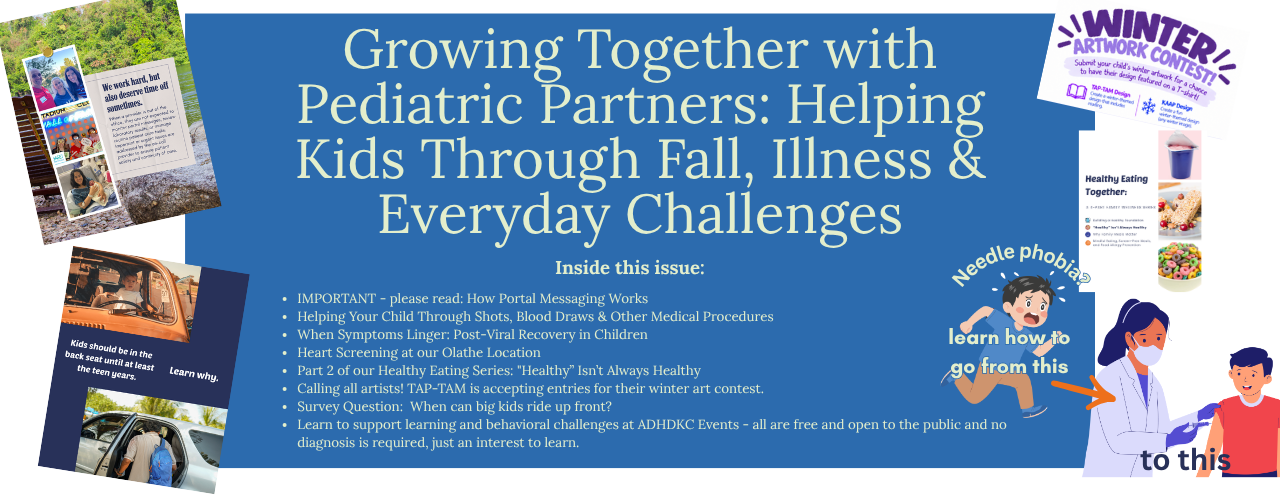
Blue event banner: “Growing Together with Pediatric Partners” with photos and a list of what's inside

October 8, 2026


Growing Together with Pediatric Partners: Helping Kids Through Fall, Illness & Everyday Challenges


Fall is officially here, and with it comes cooler weather, respiratory illnesses, school routines, and plenty of everyday parenting challenges.


In this edition of Growing Together with Pediatric Partners, we’re sharing practical information to help your family navigate the season—from what to do when your child’s symptoms linger after an illness to ways you can help make shots, blood draws, and other medical procedures less stressful.


We’re also talking about something that can make a big difference in your child’s health: learning to look beyond the words on food packages and recognizing that “healthy” doesn’t always mean what we think it does. Plus, we have an important reminder about how to contact us when your child’s usual provider is away, information about an upcoming youth heart-screening event in Olathe, car-seat safety, opportunities for young artists, and ways to connect with our local ADHDKC community.


As always, our goal is to give you practical, realistic information you can use—not to add more to your already-full parenting to-do list.


Here’s what’s inside:


This newsletter is for you, so I’d love to know what you want to see next. If there’s a topic you’ve been wondering about, or something you’d like explained more clearly, let me know. Your suggestions guide future editions and keep me inspired when I’m staring at a blank page. Use the button to let us know what you want to read about in future editions of this blog. Find answers to past surveys below and in past editions (goose eggs, heart screening follow up, COVID vaccine recommendations, and sunscreen advice.)


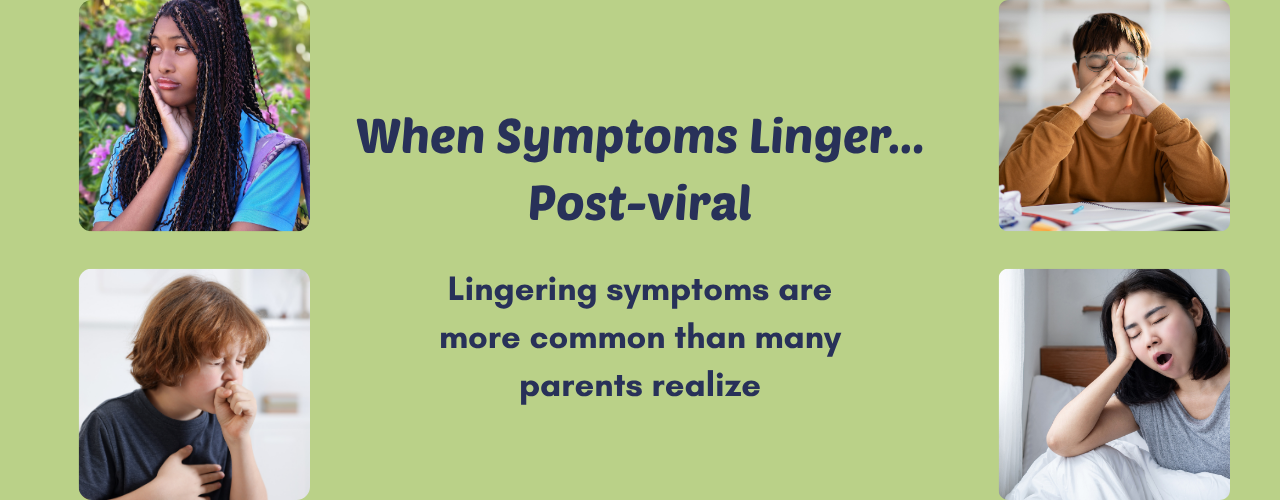
Collage of children with symptoms and text: “When Symptoms Linger… Post-viral” on a green background.

When Symptoms Linger: Post-Viral Recovery in Children


Most children bounce back quickly after a cold, the flu, COVID-19, or RSV. But doctors are increasingly recognizing that some children have symptoms that linger for weeks after the infection itself is gone. This is sometimes called a "post-viral" or "post-acute" condition. The good news: these lingering symptoms are usually temporary, and many of the infections that cause them can be prevented.


Lingering symptoms are more common than many parents realize


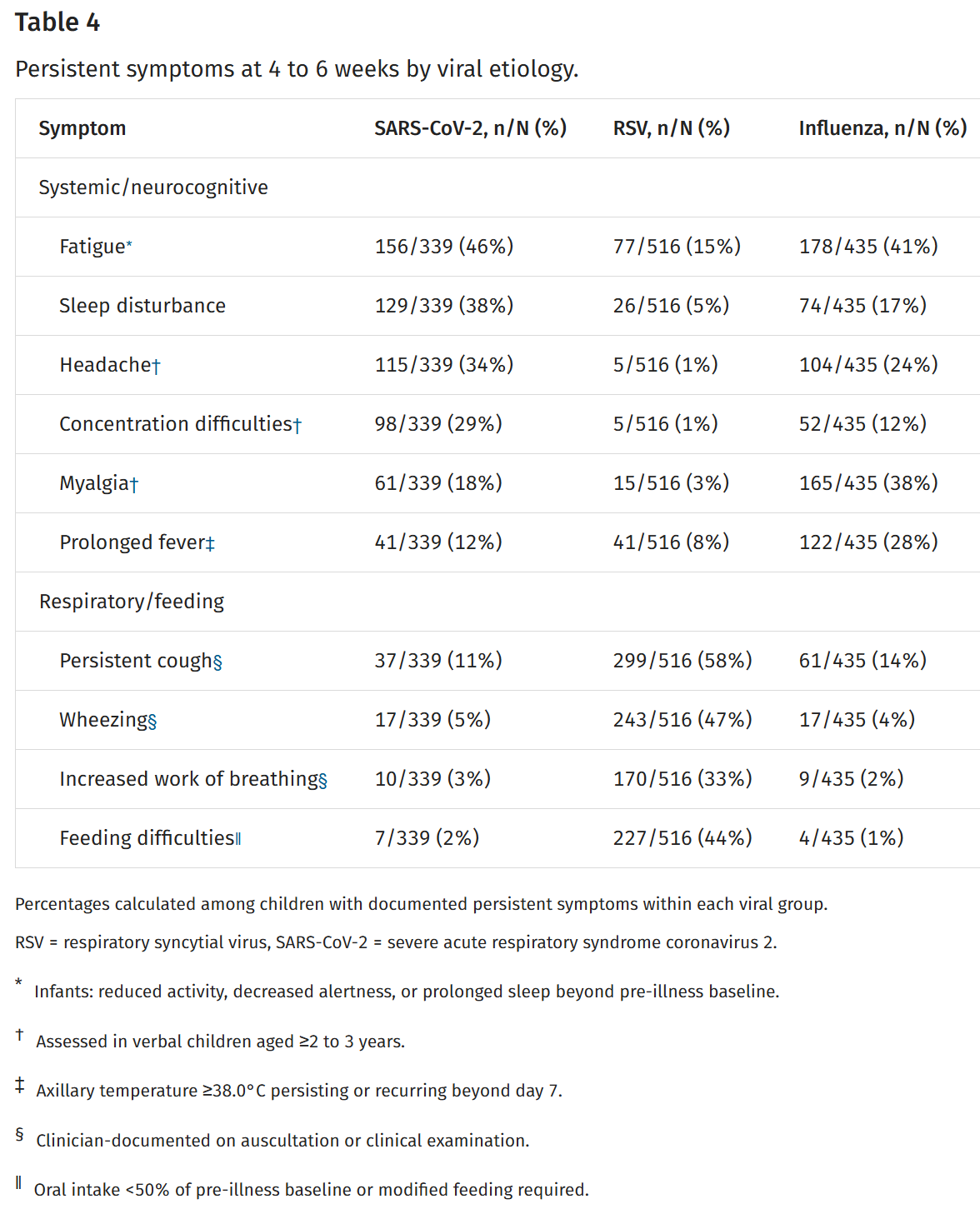
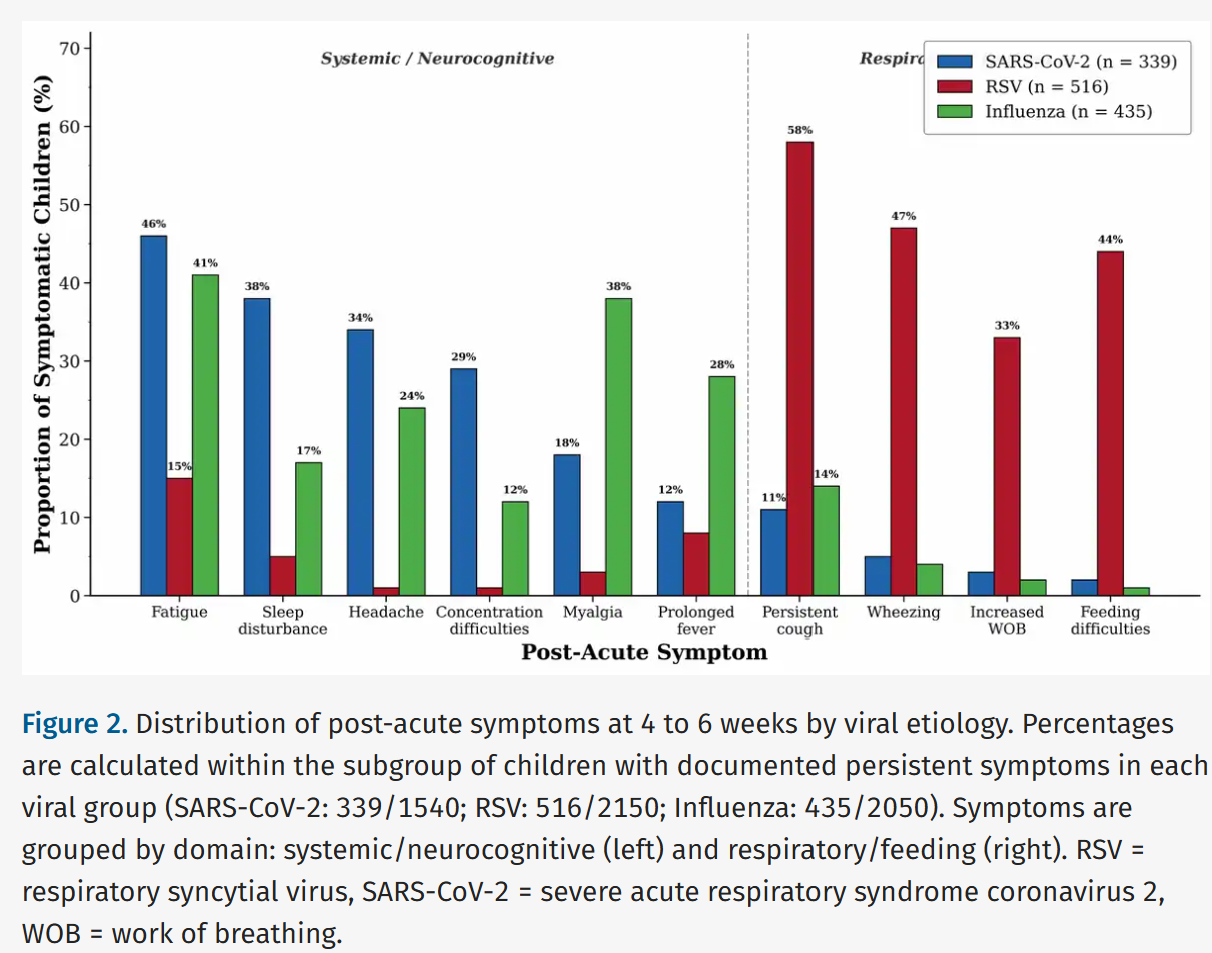
A large study of 5,740 children (Bedir and Demir, Medicine, 2026) looked at how often symptoms were still present 4 to 6 weeks after three common respiratory viruses. Roughly 1 in 5 children still had at least one symptom:

  • RSV: about 24% of children
  • COVID-19 (SARS-CoV-2): about 22% of children
  • Influenza (flu): about 21% of children


The main message from this study is reassuring but important: lingering symptoms typically self-resolve but are not unique to COVID-19. RSV and the flu can also leave children feeling unwell for weeks, so it is worth paying attention after any of these illnesses.


Each virus tends to leave a different pattern of lingering concerns.


As seen in the table and graph above, the type of lingering symptom depends a lot on which virus the child had, and on the child's age:

  • After RSV (mostly babies and infants): lingering cough, wheezing, harder or faster breathing, and feeding difficulties. Infants who had low oxygen levels, who were born prematurely, or who were under 6 months old were most likely to have lasting symptoms.
  • After COVID-19 (mostly school-aged children): tiredness (fatigue), trouble sleeping, headaches, and difficulty concentrating. School-aged children and those who were more severely ill were most affected but these have been seen even after infections that were so mild they were not recognized.
  • After the flu: tiredness, muscle aches, and prolonged or returning fever. Children who had a long fever during the illness were more likely to have lasting symptoms.


When to check in with us


Most lingering symptoms slowly improve on their own. Schedule a visit* if your child has:

  • A cough, wheezing, or fast/hard breathing that is not improving after a few weeks
  • An infant who is feeding poorly or not returning to their normal eating
  • Ongoing tiredness, headaches, sleep problems, or trouble concentrating that affects school or daily life
  • Fever that keeps coming back or lasts more than about a week


*Any symptom that lasts more than a few weeks is not suitable for urgent care unless there is a change, such as trouble breathing, blue lips, dehydration, or a child who is very hard to wake or unusually unresponsive. Any of these significant worsening of symptoms deserve urgent or emergent care, but scheduling with your primary provider is best for all chronic concerns. Do not put it off until your child's next well exam / annual physical. These are not well topics and need their own time to discuss and evaluate sufficiently.


Prevention: many of these infections are vaccine-preventable


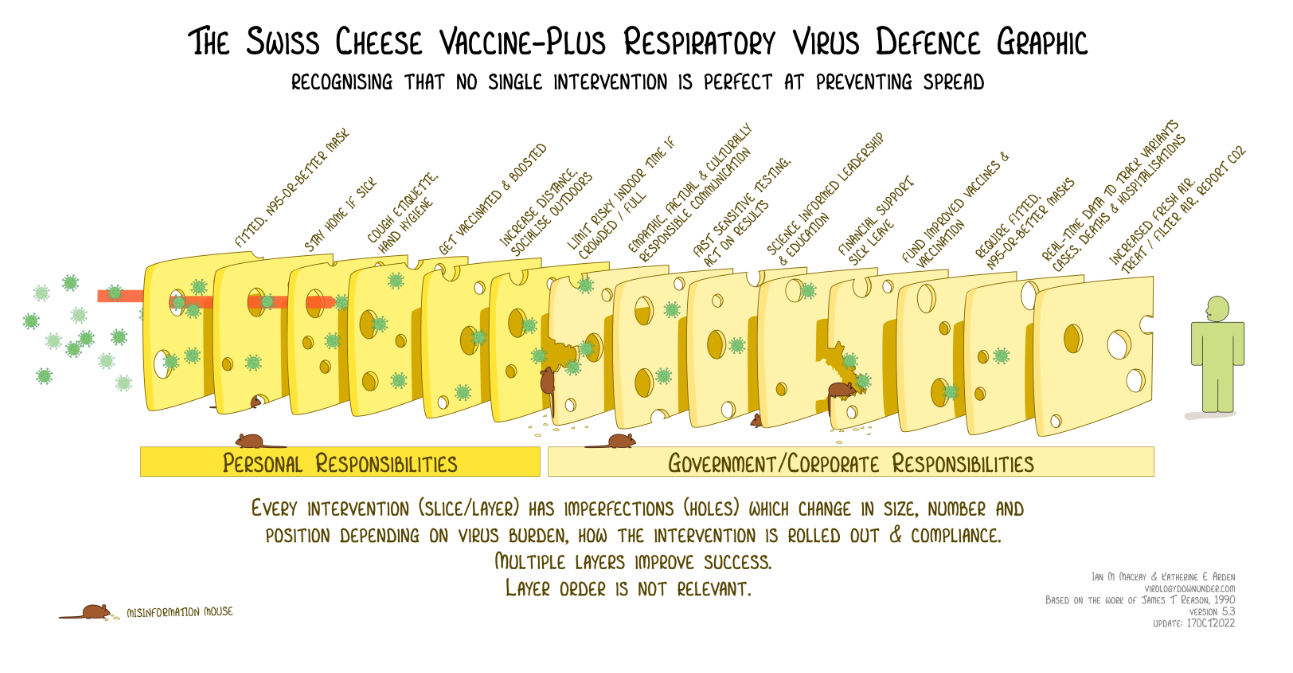
RSV, flu, and COVID-19 spread mainly through the air and through respiratory droplets when people cough, sneeze, or talk, and by touching contaminated surfaces and then the face. Preventing the infection is the most reliable way to avoid a lingering post-viral illness.


Vaccines and immunizations:

  • Flu vaccine every year (6 months and older): Across recent flu seasons, flu vaccination lowered a child's risk of a flu-related doctor visit or hospitalization by roughly one-third to two-thirds (Olson et al., Pediatrics, 2026; AAP, 2025). In the youngest children (6 months to 4 years), protection was highest. Despite this, half or more of children go unvaccinated each year.
  • COVID-19 vaccine: Updated vaccines reduce the risk of severe COVID-19 and hospitalization, and some evidence suggests vaccination may lower the risk of long COVID in children (Scott et al., New England Journal of Medicine, 2025). Follow current recommendations for your child.
  • RSV protection for babies: A single dose of an antibody shot for infants (nirsevimab) lowered RSV hospitalizations in babies under 1 year by roughly 80% (Scott et al., New England Journal of Medicine, 2025). Alternatively, an RSV vaccine given during pregnancy passes protection to the newborn. Only one of the two is needed for most babies (CDC/ACIP, 2023). After these products became widely available, RSV hospitalizations in the youngest infants dropped substantially (Patton et al., MMWR, 2025).


These vaccines can generally be given at the same visit when recommended, which makes it easier to stay up to date.


Everyday habits that reduce airborne spread:

  • Handwashing with soap and water often, especially after coughing, sneezing, or wiping noses
  • Cover coughs and sneezes with a tissue or the elbow, not the hands, and throw tissues away
  • Keep sick children home when they are ill to avoid spreading it to others
  • Clean shared surfaces and toys regularly, since viruses like RSV can linger on objects
  • Improve airflow indoors (open windows when practical, good ventilation), since crowded, poorly ventilated indoor spaces drive a large share of spread
  • Consider well-fitted masks for older children and caregivers during periods of high respiratory illness in the community or when someone at home is sick


During the COVID-19 pandemic, these same simple measures — handwashing, distancing, and masking — were shown to sharply reduce not just COVID-19 but flu, RSV, and other respiratory viruses in children.


The bottom line for parents


Lingering symptoms after RSV, flu, or COVID-19 are common and usually improve with time. Keep an eye on your child's recovery, check in with your pediatrician if symptoms drag on, and remember that staying up to date on recommended vaccines and practicing everyday healthy habits are the best ways to keep these airborne, vaccine-preventable illnesses — and their after-effects — away in the first place.

Infographic of Swiss cheese prevention for respiratory viral infections.

Helping Your Child Through Shots, Blood Draws & Other Medical Procedures


“It’s just a quick shot. It won’t hurt!”


Many of us have said something like this to our children because we want to make a painful procedure seem less scary. But there are better ways to help your child through shots, blood draws, stitches, and other procedures—and they are backed by science.


Pain and fear can become connected. A difficult experience today can make the next medical procedure even more stressful. The good news is that parents have an important role in changing that experience. Simple strategies can reduce pain and distress while helping children feel more calm, confident, and in control.


Start with a plan


Don't wait until your child is sitting in the exam room with the needle in front of them. Talk about the plan ahead of time.


For an older child, you might say:

“You’re going to have a blood draw tomorrow. It may hurt for a moment, but we can make a plan for what will help you. Do you want to watch a video, listen to music, or have me talk with you about something fun?”

Giving children appropriate choices can help them feel that they have some control over what is happening.


Don't promise that it won't hurt


It can be tempting to say, “It won't hurt!” But if it does hurt, your child may feel like you weren't being truthful—and that can make future procedures harder.


Instead, be honest without making the pain the focus:

“You may feel a quick pinch. I'll be right here, and we'll use some things that can make it more comfortable.”


Comfort your child rather than holding them down whenever possible


When a child is frightened, our first goal should be to help them feel safe and supported—not to simply hold them down and get the procedure over with.Comfort your child rather than holding them down whenever possible


When a child is frightened, our first goal should be to help them feel safe and supported—not to simply hold them down and get the procedure over with.


A comfort position can be very helpful. Depending on the child's age and the procedure, this might mean sitting on a parent's lap, being held close, or having a parent provide a secure hug while keeping the part of the body needed for the procedure accessible. These positions can reduce distress and often make it easier to safely complete the procedure.


But let's also be realistic: sometimes a procedure simply has to be done.


You may have tried distraction, breathing, preparation, a comfort position, a favorite video, and reassurance—and your child may still be crying, kicking, or trying to get away. Some procedures cannot be postponed indefinitely. A vaccine has been prepared and needs to be administered. A blood sample may be needed for an important medical decision. A wound may need to be treated. And in a busy medical office, we cannot always spend an unlimited amount of time waiting for a child to become completely calm.


In those situations, safety comes first. Sometimes a child needs to be held still long enough for the procedure to be completed safely. That isn't the outcome we want, but it is sometimes the reality of providing necessary medical care.


The important distinction is how we get there.


We don't want to begin with holding them down. We want to give the child a chance to use coping strategies and maintain as much control and comfort as possible. If those strategies aren't enough and the procedure still needs to happen, the healthcare team can use the least restrictive, safest approach necessary to complete it.


And once it's over, don't shame the child for how they responded. A child who needed to be held still wasn't “bad,” “dramatic,” or “difficult.” They were overwhelmed. You can say:


“That was really hard. You were scared, and you got through it. I'm proud of you.”

This is also an opportunity to make the next procedure easier. Talk with your child's healthcare team about what worked, what didn't, and what could be done differently next time. For children who have significant procedural anxiety, planning ahead can make a big difference.


Give their brain something else to do


Distraction isn't just “trying to make them forget.” It is an evidence-based strategy for reducing pain and distress during many procedures. Depending on your child's age, try blowing bubbles, playing a game, watching a favorite video, listening to music, telling a story, or having a conversation about something completely unrelated to the procedure.


And parents can help by participating in the distraction rather than repeatedly asking, “Are you okay?” or “Does it hurt?”


Reduce the pain when you can


Pain management doesn't have to mean simply helping a child cope with pain. We should also look for ways to prevent or reduce the pain itself.


Depending on the procedure and your child's age, options may include topical numbing medication, comfort positioning, vibration, cooling, breastfeeding for infants, and other techniques. Ask your child's healthcare professional what is appropriate for the particular procedure.


Your calm matters—but you don't have to pretend


Children are remarkably good at picking up on our emotions. That doesn't mean you need to act as though you're completely fearless. Instead, try to be a calm coach.


Rather than:


“Oh no! Don't be scared! This is going to be okay!”

Try:


“I know this isn't your favorite thing. You can do hard things. I'm right here. Let's use your plan.”

The goal isn't to convince your child that there is nothing to be afraid of. The goal is to teach them that they have tools to get through something that is uncomfortable or scary.


A great resource for parents


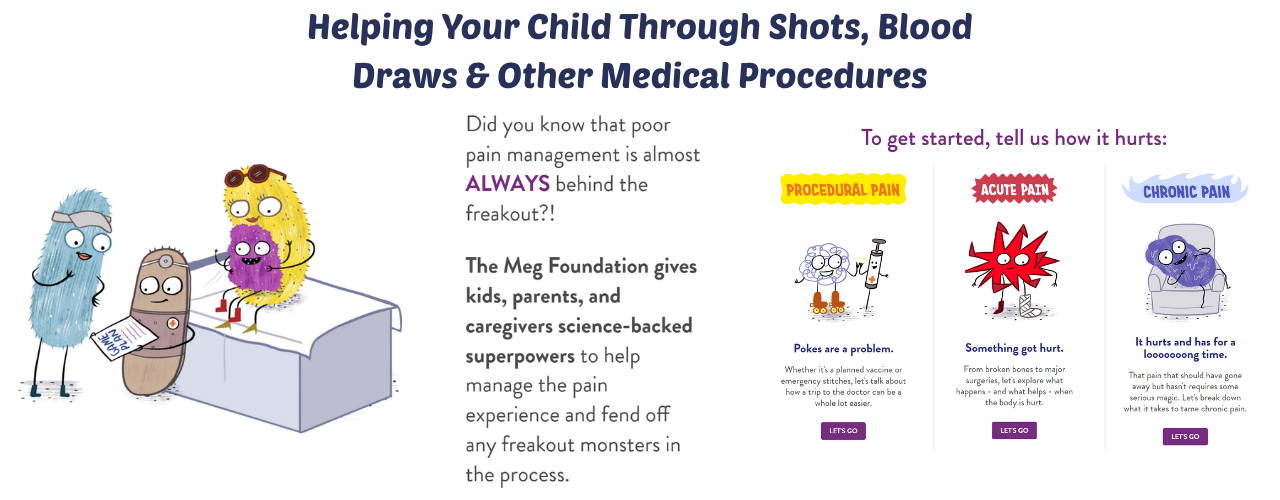
One of my favorite resources for learning more about helping children through painful procedures is the MEG Foundation. They have practical, evidence-based resources for parents and kids, including comfort plans for shots and blood tests, information about numbing cream, comfort positioning, distraction, and other strategies.


Medical procedures don't have to be something children simply endure. We can help them experience less pain, less distress, and more confidence—and those skills can make the next experience easier, too.


If you need more


Our clinical social worker, Sean, can work with your child to learn how to manage needle phobia and other medical procedures.


Don't wait until your child's next well visit to talk about this. Working with any therapist to manage needle phobia typically takes 6 to 12 sessions (about 2 to 3 months), though some individuals can show significant improvement in as few as 2 to 6 sessions.


Preparing ahead of anticipated shots can make a world of difference. Call our office to schedule your first session about 3 months before anticipated shots or other medical procedures.


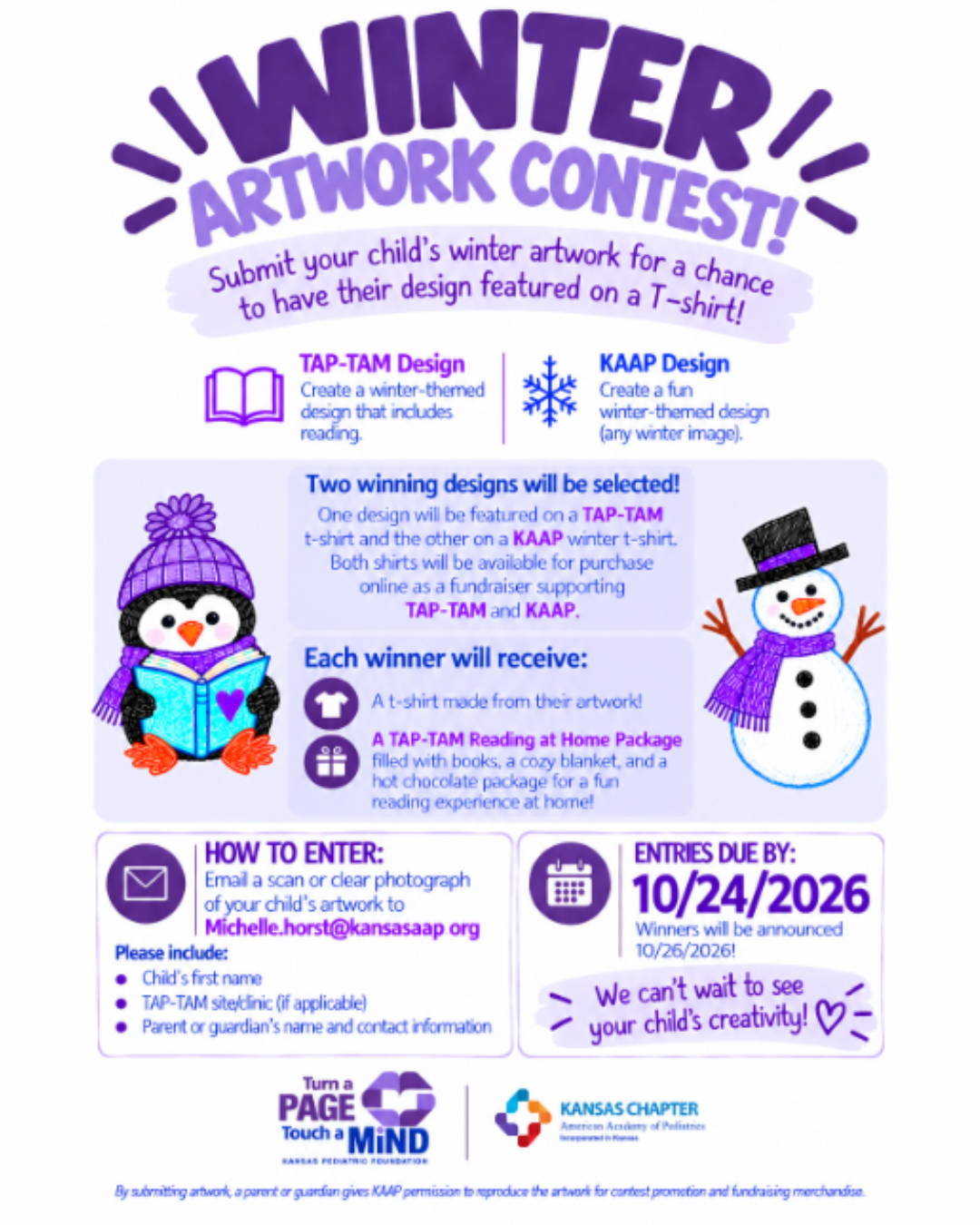
Winter artwork contest poster with purple title, penguin and snowman, submission details, and Oct. 24, 2026 deadline

Calling all artists!


We are thrilled to share information about the TAP-TAM annual Winter Artwork Contest and invite youth to submit winter-themed drawings. This not only lets young artists show their talents, but also supports vital pediatric initiatives across Kansas.


Two winning designs will be featured on TAP-TAM and KAAP T-shirts, available for purchase in early November.


Entries are due by October 24th and should be sent to michelle.horst@kansasaap.org. Your TAP-TAM site is Pediatric Partners - they are the sponsors of all the books we give to kids.


Each winner will receive a free T-shirt and a TAP-TAM Reading at Home Package, promoting literacy and comfort. Proceeds from T-shirt sales will directly benefit TAP-TAM and KAAP programs.


Join us in celebrating creativity and supporting pediatric health!


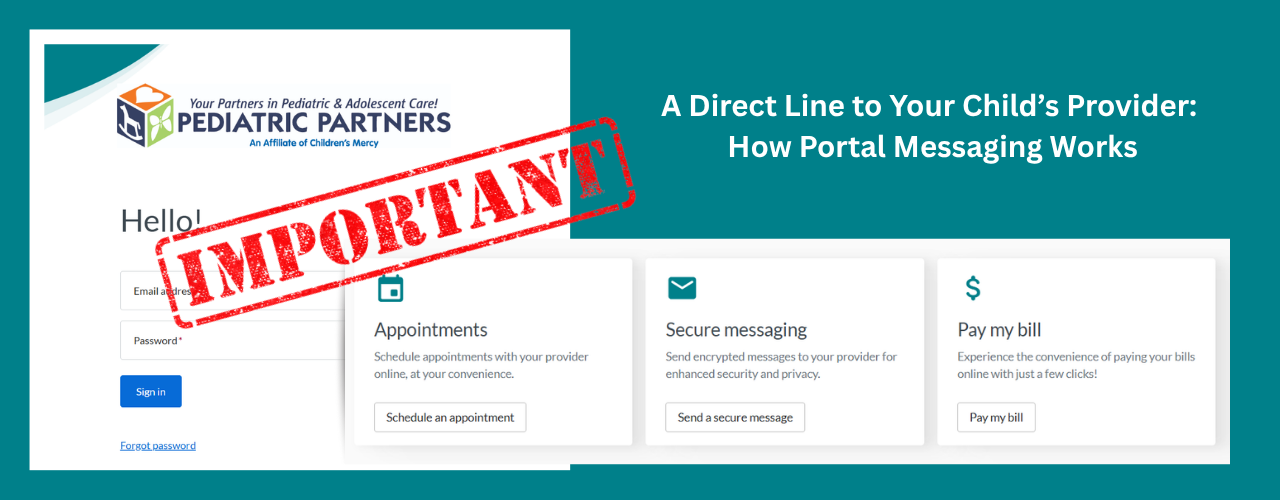
Patient portal webpage for Pediatric Partners with a red “IMPORTANT” stamp and login help panel.

A Direct Line to Your Child’s Provider: How Portal Messaging Works


Did you know that our physicians and nurse practitioners answer their own patient portal messages?


Unlike some healthcare practices where nurses or other staff manage portal communication, your message at Pediatric Partners goes directly to the person who knows your child’s care best.


We love that this provides a direct line of communication between you and your child’s healthcare provider. However, it also means that when your provider is out of the office, messages may not receive a response until they return.


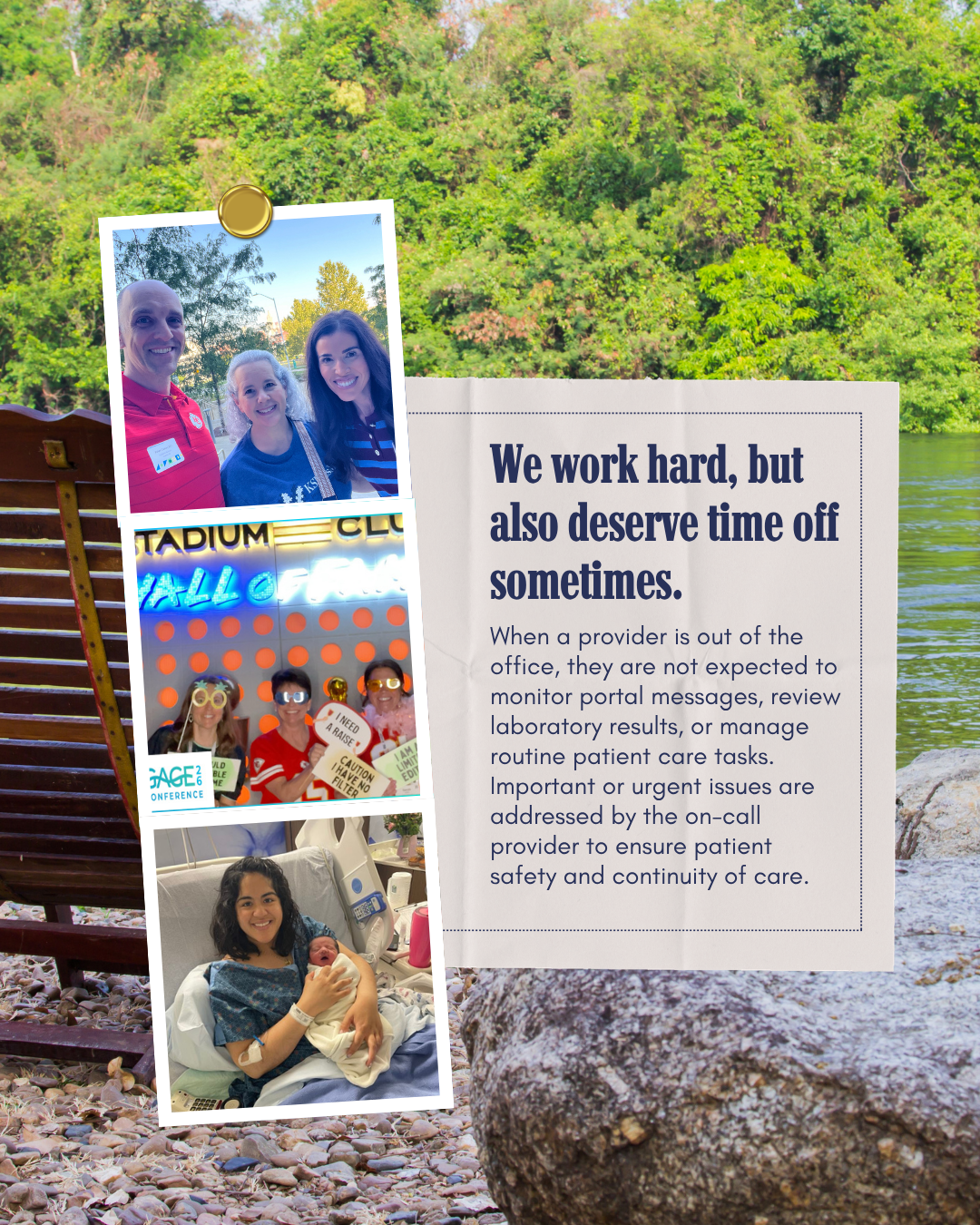
Collage of photos of physicians and staff at conferences and Dr Khaleghi with her newborn and a quote reading, “We work hard, but also deserve time off sometimes,” outdoors.

What happens when your provider is away?


Our physicians and staff are deeply committed to providing the best possible care to our patients. When we are at work, we work hard to meet your healthcare needs. Just as everyone does, however, we also need time away from work.


Sometimes that time is for vacation, sometimes it's to care for family members, attend important family events, or simply take care of responsibilities at home. Whatever the reason, time off is important and necessary.


When a provider is out of the office, they are not expected to monitor portal messages, review laboratory results, or manage routine patient care tasks. Important or urgent issues are addressed by the on-call provider to ensure patient safety and continuity of care.


To help us maintain this balance, please do not send portal messages to another provider asking them to answer or forward a message to your preferred provider while they are away. Providers disable portal messaging when out of the office for this reason. If you have a question or concern, please call the office, and our staff will direct your message to the most appropriate person.


We appreciate your understanding, patience, and respect for the time our physicians and staff spend away from work. Taking this time allows us to return refreshed and ready to provide the high-quality care you deserve.

Unfortunately, sometimes people find an older message and reply to that conversation. While this may seem like a reasonable way to reach out if you don't see their name in the drop down of options, those replies may not be seen for several days. Families then understandably call the office to speak with a nurse about the same concern.


Here’s where things become more complicated behind the scenes:

  1. The nurse discusses the concern with the on-call provider to determine how best to help your child.
  2. The nurse also sends a message to your child's usual provider, who is out of the office, to keep them informed.
  3. The returning provider then has messages from both you and the nurse regarding the same issue when they get back.

This leads to a very full in box and confusion as to what has already been addressed and what still needs to be handled.


How you can help


If you cannot send a new portal message to your child's provider or another staff member, please call our office instead.


Calling allows our nursing team to address your concern promptly, consult with the on-call provider when needed, and ensure the appropriate information is shared with your child's usual provider.


This approach helps you get an answer sooner, reduces duplicate communication, and allows our team to focus on providing the best care possible for all of our patients.


Thank you for helping us make communication more efficient while preserving the direct connection you value with your child's healthcare provider!


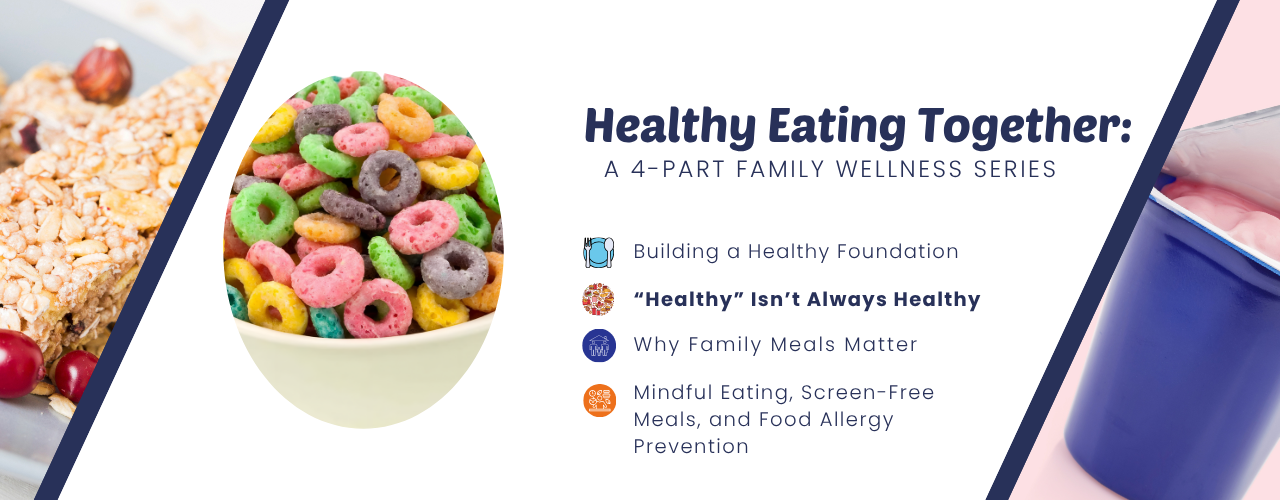
Healthy eating flyer with cereal, yogurt, grapes, and text about balanced snacks

Part 2 of Healthy Eating Together: "Healthy Isn't Always Healthy


The Truth About “Healthy” Snacks: Reading Between the Labels


Healthy eating starts with making informed choices—but sometimes the foods marketed as healthy aren't quite what they seem.


Walk through a grocery store and you'll find plenty of foods promising to help your family eat better. “All natural.” “Made with whole grains.” “Good source of vitamins.” “No artificial ingredients.” “Packed with real fruit.”


These claims can make shopping feel easier. After all, if a package says it's healthy, why wouldn't we choose it?


The challenge is that a food can have some nutritional benefits and still contain more added sugar than you might expect.


Understanding food labels and looking beyond marketing claims can help families make choices that support health without turning grocery shopping into a stressful research project.


And as we discussed in Part 1, this isn't about perfection. It's about learning how to make informed choices most of the time.


Why Does Added Sugar Matter?


Sugar is not inherently bad. Our bodies use glucose for energy, and naturally occurring sugars are found in nutritious foods such as fruit and milk.


The bigger concern is excessive intake of added sugars—sugars added to foods and beverages during processing or preparation.


Many children consume more added sugar than recommended, often without realizing it. Sugary drinks, snacks, breakfast foods, and desserts can contribute significant amounts throughout the day.


Too much added sugar over time can contribute to:

  • Dental cavities
  • Excess calorie intake
  • Increased risk of unhealthy weight gain
  • Higher risk of type 2 diabetes and cardiovascular disease when part of an overall unhealthy dietary pattern


For some children, sugary foods and drinks can also displace more nutrient-dense choices. A child who fills up on sweetened beverages may have less appetite for foods that provide protein, fiber, vitamins, and minerals.


The goal isn't to eliminate sugar. It's to recognize where it shows up and make thoughtful choices.


Foods That May Not Be as Healthy as They Appear


Let's look at some common examples.


1. Flavored Yogurt


Yogurt can be an excellent source of protein and calcium. It may also contain beneficial live cultures.

But some flavored yogurts contain substantial amounts of added sugar—especially those marketed toward children.


A better option: Try plain yogurt with fresh or frozen fruit mixed in. You can also choose a lightly sweetened yogurt and gradually transition toward less added sugar.


For younger children, full-fat plain yogurt may be a useful option depending on their developmental stage and overall dietary needs.


You don't have to make the switch overnight. Even mixing half plain yogurt with a child's usual favorite can be a reasonable starting point.


2. Granola Bars and “Healthy” Snack Bars


Granola bars often have a wholesome image because they contain oats, nuts, or whole grains.

But some varieties also contain added sugars, syrups, chocolate coatings, or candy-like ingredients.


That doesn't make every granola bar a poor choice. It simply means the label is worth checking.


Look for: Whole grains, nuts or seeds, fiber, and protein, with less added sugar when possible.


A granola bar can be a convenient snack—particularly for busy families. Just remember that convenience and nutrition can coexist without every bar being a nutritional powerhouse.


3. Breakfast Cereals


Some cereals provide whole grains, iron, and other important nutrients. Others are essentially sweetened snacks served in a bowl.


Even cereals that contain added vitamins and minerals may still have considerable added sugar.


Try comparing labels. Look for cereals with whole grains listed among the first ingredients and less added sugar.


You can also combine a sweeter cereal with a lower-sugar option rather than demanding that your child immediately abandon a favorite.


Serve cereal with milk or yogurt and fruit to create a more balanced breakfast.


4. Smoothies


Smoothies can be a wonderful way to combine fruits, vegetables, yogurt, and other nutritious ingredients.


But not all smoothies are created equal.


A smoothie made with whole fruit, plain yogurt, and milk is different from one made primarily with fruit juice, flavored yogurt, and sweetened ingredients.


Even a homemade smoothie made entirely from fruit can contain a substantial amount of naturally occurring sugar while providing less fiber than eating whole fruit, depending on preparation.


A better approach: Include protein and fiber, such as plain yogurt, nut butter, seeds, or oats, and use whole fruit rather than juice as the base.


Smoothies don't need to be avoided. Just think about what goes into them.


5. Fruit Snacks


The word “fruit” on a package can be misleading.


Many fruit snacks are made primarily from fruit juice concentrates, added sugars, and gelatin or other ingredients. They may contain little of the fiber found in whole fruit.


Whole fruit is generally a better everyday choice.


Apples, berries, oranges, bananas, and grapes provide fiber and require children to experience different textures and flavors.


Fruit snacks can still be an occasional food. They simply shouldn't replace fruit as a regular part of the diet.


6. Flavored Oatmeal


Oatmeal is a nutritious whole grain that provides fiber and can be a great breakfast choice.


But some flavored oatmeal packets contain added sugars that turn a healthy base into a much sweeter meal.


Try plain oats with:

  • Bananas or berries
  • Cinnamon
  • Peanut or other nut butter, if tolerated and age-appropriate
  • Chia or ground flax seeds
  • Milk or yogurt
  • Chopped nuts for older children who can safely eat them


This allows your family to control the sweetness while adding nutrients and flavor.


7. Honey


Honey has a reputation for being a healthier alternative to table sugar. It's natural, comes from bees, and contains small amounts of antioxidants and other plant compounds. So many parents feel better adding honey to their child's oatmeal or smoothie than adding ordinary sugar.


We even recommend honey for those over a year of age to help treat their cough. It does have great properties!


But when it comes to added sugar, honey isn't the health food many people believe it is. It is still primarily sugar (mostly glucose and fructose) and your body processes those sugars much like the sugars found in table sugar. While honey may contain trace amounts of antioxidants and minerals that aren't present in significant amounts in refined sugar, those small nutritional differences don't outweigh the fact that honey contributes added sugar to the diet.


The American Heart Association includes honey among the sweeteners counted as added sugars. The body doesn't give honey a free pass simply because it comes from a natural source.


Some people point out that honey may have a slightly lower glycemic index than table sugar, depending on the variety. This means it may cause a somewhat different rise in blood glucose.


However, this doesn't make honey a low-sugar food or mean you can use unlimited amounts. The total amount of sugar consumed still matters, and honey can contribute to excessive added sugar intake just like other sweeteners.


What should you use instead?


If you're sweetening oatmeal or a smoothie, consider letting the natural sweetness of fruit do the work:

  • Add mashed banana to oatmeal.
  • Blend berries or mango into a smoothie.
  • Sprinkle cinnamon for extra flavor.
  • Choose plain yogurt and add fruit rather than relying on sweetened varieties.


And if you enjoy honey? There's no need to fear it or eliminate it. A little honey is fine, but it should be viewed as a sweetener, not a nutritional upgrade over sugar.


One important reminder for families: Honey should never be given to infants younger than 12 months because of the risk of infant botulism.


The bottom line: Whether sweetness comes from a bee, a sugar cane plant, or a factory, it is still added sugar when we mix it into our food.


How to Read a Food Label Without Becoming Overwhelmed


You don't need a degree in nutrition to make informed choices.


Start with three simple steps.


1. Look at the serving size


The nutrition information is based on the listed serving size—not necessarily the amount your child will eat.


A package may contain two or more servings, even if it looks like a single snack.


2. Check the added sugars


The Nutrition Facts label separates total sugars from added sugars.

  • Total sugars include naturally occurring sugars, such as those in fruit and milk, as well as added sugars.
  • Added sugars are those introduced during processing or preparation.


When comparing similar products, looking at added sugar can help you identify which options are less sweetened.


3. Scan the ingredient list


Ingredients are listed in descending order by weight.


If sugar, corn syrup, honey, or another sweetener appears near the beginning of the ingredient list, the product may contain a significant amount of added sugar.


And remember, sugar can have many names, including:

  • Cane sugar
  • Brown sugar
  • Honey
  • Maple syrup
  • Agave nectar
  • Corn syrup
  • Rice syrup
  • Fruit juice concentrate


Some of these ingredients may sound more natural, but your body still processes the sugars they contain.


Natural-sounding ingredients aren't automatically healthier.


Don't Let “Natural” or “Organic” Do All the Thinking for You


Words such as “natural,” “organic,” “multigrain,” and “made with real fruit” may describe something about a product, but they don't tell the whole nutritional story.


Organic and conventionally grown foods have very similar amounts of vitamins, minerals, and other key nutrients.


Natural is an unregulated marketing term, so it is not helpful to look for "natural" on the label when choosing foods to serve your family.


For example:

  • A cookie can be organic and still high in added sugar.
  • A granola bar can contain whole grains and still be heavily sweetened.
  • A fruit drink can contain 100% real fruit juice and still be a sugary beverage.
  • A product labeled “multigrain” may contain several grains without being primarily whole grain.


Marketing is designed to catch our attention. Nutrition labels help us understand what we're actually buying. Neither requires us to become suspicious of every package. They simply remind us to look at the whole picture.


Simple Swaps That Can Make a Difference


Small changes often work better than dramatic overhauls.

  • Swap plain yogurt with fruit instead of sweetened yogurt.
  • Offer water for most drinks and save sugary drinks, including fruit juice, for special occasions.
  • Serve fresh, frozen, or canned fruit in water instead of fruit snacks.
  • Skip the sweetened oatmeal and make plain oats with fruit and cinnamon.
  • Make smoothies with some or all of the following: fruit, plain yogurt, vanilla, vegetables, oats, nuts
  • Bake 2-ingredient cookies with banana and oats and consider adding cinnamon, nuts, and other healthy flavors for variety instead of giving traditional cookies.
  • Use unsweetened peanut butter rather than the popular sugar-added brands.


These are suggestions, not strict rules.


Kids will resist change, so start slow. If your child loves sweetened yogurt, try combining it with plain yogurt. If they only eat one particular cereal, mix it with a less-sweetened variety. If your family relies on convenience foods, look for small improvements rather than eliminating everything that comes in a package.


A healthier choice is still a healthier choice—even if it isn't the “perfect” choice.


What About Juice?


Juice deserves special attention because it is often perceived as a healthy drink.


Fruit juice can provide some vitamins and minerals, but it lacks much of the fiber found in whole fruit and can deliver a significant amount of sugar.


For most children, whole fruit is the better everyday choice.


The American Academy of Pediatrics recommends limiting juice intake, particularly in young children:

  • Infants younger than 12 months should not routinely be given fruit juice.
  • Children ages 1–3 years: No more than 4 ounces daily.
  • Children ages 4–6 years: No more than 4–6 ounces daily.
  • Children ages 7–18 years: No more than 8 ounces daily.


Water and milk are generally better everyday beverages.


And don't forget that many drinks marketed to children—including sports drinks, flavored waters, and fruit beverages—may contain added sugar.


Teaching Children Without Creating Food Fear


As parents, we want to help our children make healthy choices. But how we talk about food matters.

If children hear that sugar is “poison,” that certain foods are “bad,” or that eating dessert means they have failed, they may begin to associate food with guilt or anxiety.


Instead, try neutral, informative language:

  • “This cereal has a lot of added sugar. Let's compare it with another option.”
  • “Fruit gives us fiber and vitamins, while fruit snacks are a sweet treat.”
  • “Water helps keep our bodies hydrated.”
  • “We can enjoy cookies sometimes and also eat foods that help our bodies grow.”


The goal is to teach children how to think about food—not to make them afraid of it.


This becomes especially important as children grow into teenagers and young adults, when they will make more food choices independently.


Healthy Eating Doesn't Have to Be Expensive or Complicated


Some families worry that eating healthy means buying expensive specialty products or spending hours preparing meals. There are healthy options that are not going to break the bank or take a lot of prep time.


Nutritious, budget-friendly choices can include:

  • Oatmeal
  • Eggs
  • Beans and lentils
  • Frozen vegetables
  • Canned fruits packed in water
  • Peanut butter or other nut butters
  • Brown rice
  • Whole-grain pasta
  • Plain yogurt
  • Seasonal produce


Frozen and canned foods can be incredibly helpful for busy families. They last longer, reduce food waste, and can make it easier to include a variety of foods throughout the week.


The healthiest plan is one your family can realistically maintain.


The Bottom Line: Awareness, Not Perfection


Learning to recognize hidden sugars and understand food labels can help families make better choices.

But this isn't about scrutinizing every bite or turning grocery shopping into a test.


It's about gradually building awareness, helping children understand that foods serve different purposes and making nutritious foods accessible while allowing room for enjoyment.


And it's about modeling balance rather than perfection because healthy eating is not defined by one snack, one meal, or one day. It's the pattern we create over time.


In Part 3 of our Healthy Eating Together series, we'll explore why sitting down to eat as a family can benefit far more than nutrition.


A Few Questions to Consider This Week


  1. Is there one food or beverage your family consumes regularly that you could compare with a less-sweetened alternative?
  2. Could you add one more fruit or vegetable to a meal each day?
  3. Can you involve your child in reading a label or choosing between two options at the grocery store?


Small changes count. And every opportunity to teach children about nourishing their bodies is an investment in their future.

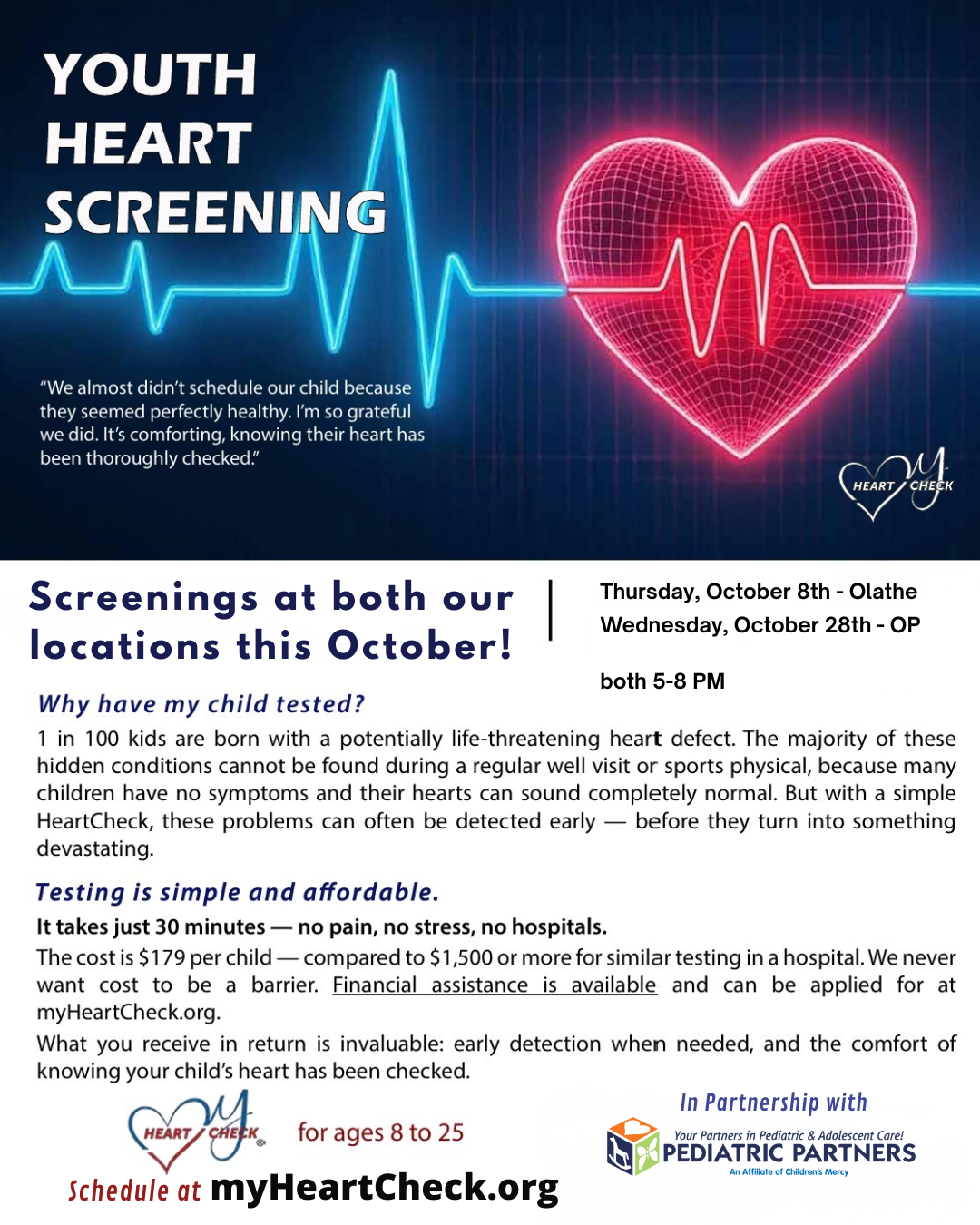
Youth Heart Screening flyer with neon heart and ECG line on dark blue background, plus event details as described in the text.

Heart Screening Events Are Coming to Our Offices Again


Our Olathe location will host a My HeartCheck youth heart screening on Tuesday, October 8th from 5–8 PM.


Our Overland Park office will host a screening on Wednesday, Oct. 28th from 5pm to 8pm.


My HeartCheck is a trusted community partner that provides
comprehensive, non‑invasive heart screenings for individuals ages 8–25 — and participants do not need to be Pediatric Partners patients to schedule.


Each 30‑minute screening includes:

• ECG (electrical activity) 

• Echocardiogram (cardiac ultrasound) 

• Blood pressure check 

• Health & family history review 

• Results reviewed by a pediatric cardiologist


The cost is $179, and financial assistance is available so no child misses the opportunity for early detection and peace of mind.


If this session is full, remember that our patients can go to any of their public screenings and that we'll host them again soon.


Blue “Survey Follow Up” banner with a smartphone and message icon at the right

Since the last blog, our survey only had one submission: When can big kids sit up front in the car?

Text says kids should be in the back seat until at least 13 and there is a picture of a young girl standing behind the steering wheel of an old car and another of a tall child getting in the back seat with a backpack.

Keep Kids In Back: The front seat is safe for teens and adults only


Another question from our Survey: When can big kids sit up front?


The short answer: Children younger than 13 are safest riding in the back seat, no matter how mature or tall they seem.

This is the recommendation of the American Academy of Pediatrics (AAP), and it applies every trip, every time.


Why the back seat is safer


  • It is farther from the crash. In most serious collisions, the front of the car takes the worst impact. Riding in the back puts more of the car between your child and the point of impact.
  • The numbers are clear. Studies show children riding in the front seat have roughly a 40% to 70% higher risk of injury than children riding in the back. The back seat protects in side-impact crashes too—children in the rear are about 62% less likely to be hurt.
  • Front airbags are built for adults, not kids. Airbags deploy with tremendous force and speed to protect a full-grown adult. That same force can seriously or fatally injure a child, striking the head, neck, and chest. This danger is why the recommendation to keep children in the back began in the first place.


Why 13 is the cutoff


Children under 13 have smaller, under-developed bones, especially their breastbones (sternum) and skulls. If they are not at least 4 ft 9 inches they also sit too low for the air bag to hit their chest, and it instead may hit their head. This makes them more vulnerable to the blunt-force trauma of an adult-sized airbag. Even tall kids do not have the bone maturity of teens, so are at higher risk in an accident.


Research shows that the safety benefit of the back seat holds for children up to about age 13. Around the teen years, a child's body is closer to adult size, and the front seat becomes as safe for them as it is for adults. Smaller teens will still be safest in the back seat.


A few important reminders and tips


  • Always use the right restraint for your child's size—rear-facing seat, forward-facing seat, booster, or seat belt—and keep them in each stage as long as they fit within the height and weight limits. Do not rush the next step.
  • A seat belt alone is not enough until it fits properly: the shoulder belt across the middle of the chest and shoulder (not the neck), the lap belt low across the hips (not the belly), with your child sitting all the way back with knees bent at the seat edge. This usually happens around 4 feet 9 inches tall and between ages 10 and 12.
  • The center of the back seat, when a good belt or seat fit is possible there, is often the safest single spot because it is farthest from all sides of the car.
  • If a child must ride in front (for example, a truck with only one row of seats), move the seat as far back as it goes and, if possible, have the front passenger airbag switched off.


The bottom line for parents


Keeping your child in the back seat until age 13 is one of the simplest, most effective things you can do to protect them in the car. Buckle up correctly, back seat, every ride.


Manage your home with better strategies

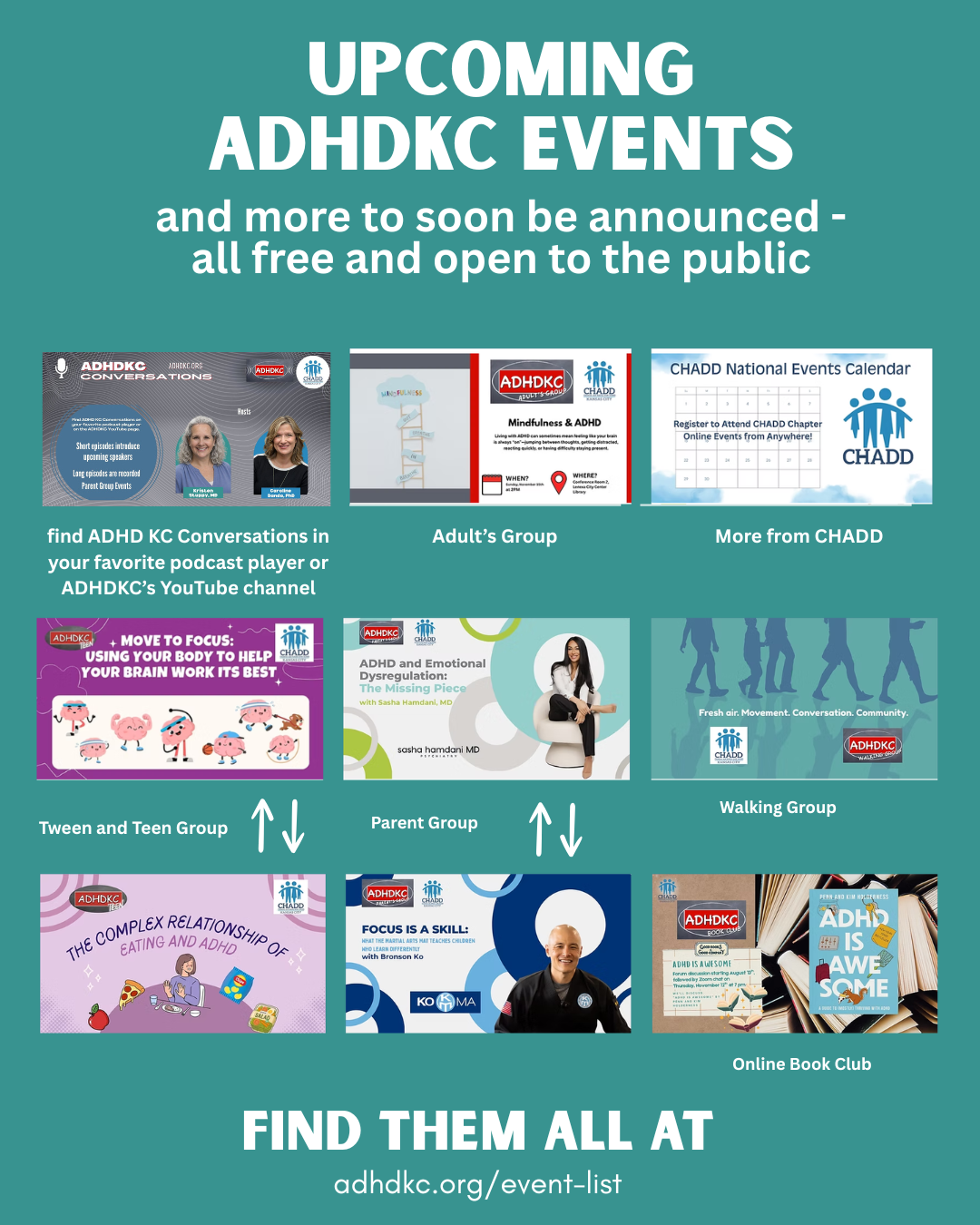
adhdkc fall events with screen shots of each event coming soon

Learn About Upcoming Free Community Events from Our Local CHADD Chapter


Founded in 2012, ADHDKC is Kansas City’s Award Winning Non-Profit CHADD Chapter. ADHDKC provides support for thousands of area families thriving with ADHD and related conditions. Every month ADHDKC sponsors events online and around the KC Metro to help parents, adults, and adolescents learn how to regulate emotions, better manage executive functioning, and more. 


Since ADHD affects about 6% of adults and 10% of kids, we know many of you live with the challenges of having ADHD in the home. The good news is that you can learn to better support your family. ADHDKC offers monthly events for parents, adults, and teens to help you learn to thrive with ADHD. 


ADHD KC Conversations is their podcast, which is shared on your favorite podcast player and in video form on YouTube. It offers a glimpse into upcoming parent group speakers with a short interview released a month prior to their talk and longer episodes of the parent group talks.


Dr Stuppy always likes to see new faces in the group for middle and high schoolers that she leads each month. They meet the first Tuesday of the month at 5:30 pm online for an interactive learning session that motivates youth to take control of their lives. A diagnosis of ADHD is not needed to join us. 


All ADHDKC Events are free and open to the public. No diagnosis is required! You just need an interest in the topic to join us.  Feel free to share this with friends and family who would benefit. 

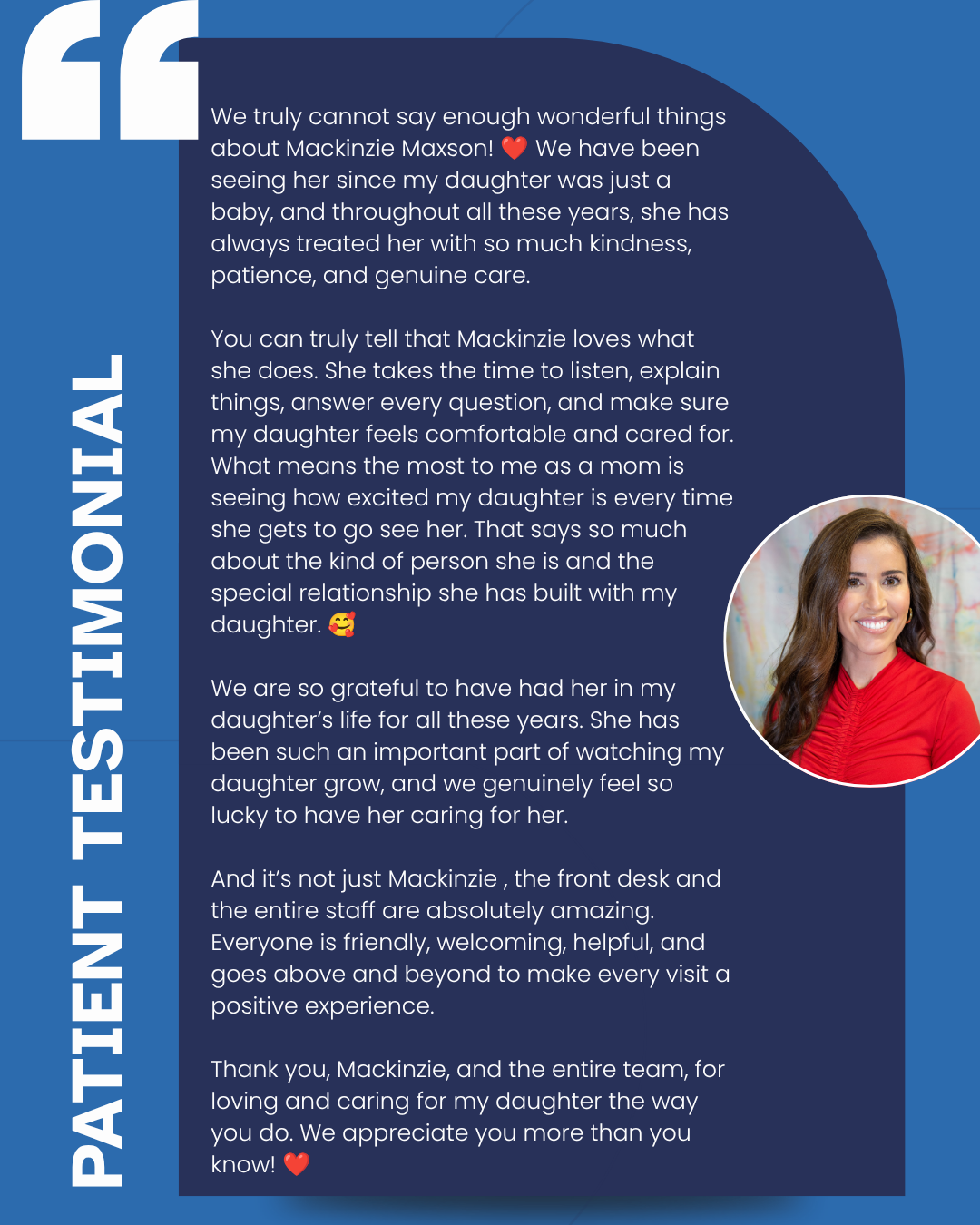
Patient Testimonials


Blue testimonial graphic with a phone user photo, large white quotes, and a dark text box titled “PATENT TESTIMONIAL. Absolutely love all the doctors and nurses! This practice is the best I've experienced and lived in 3 states since we had children, nothing has come close to the care we have received here! Absolutely love they have same day sick appointments and walk in hours! Emily Ben Alaya”
Blue patient testimonial card with white quotation marks and a small circular photo of a phone in hand. In the quote, it reads patient testimonial - The option of the walk in clinic in the mornings and late afternoons have been a blessing with having a kiddo in daycare w/ multiple illnesses over the last year. From the efficient kind staff at the check in desk to the nsg staff and the NPs giving such great care I feel as if we have been saved from many ER visits as they catch things quickly and give wonderful medical care. Highly recommend the OP office. Ashley Krstic

If you enjoyed this edition of Growing Together with Pediatric Partners, share it with a friend.

Share