Raising Capable Kids: How to Build Independence and Resilience
June 18, 2026
Swing by and Say Hi at Deanna Rose! 🐄
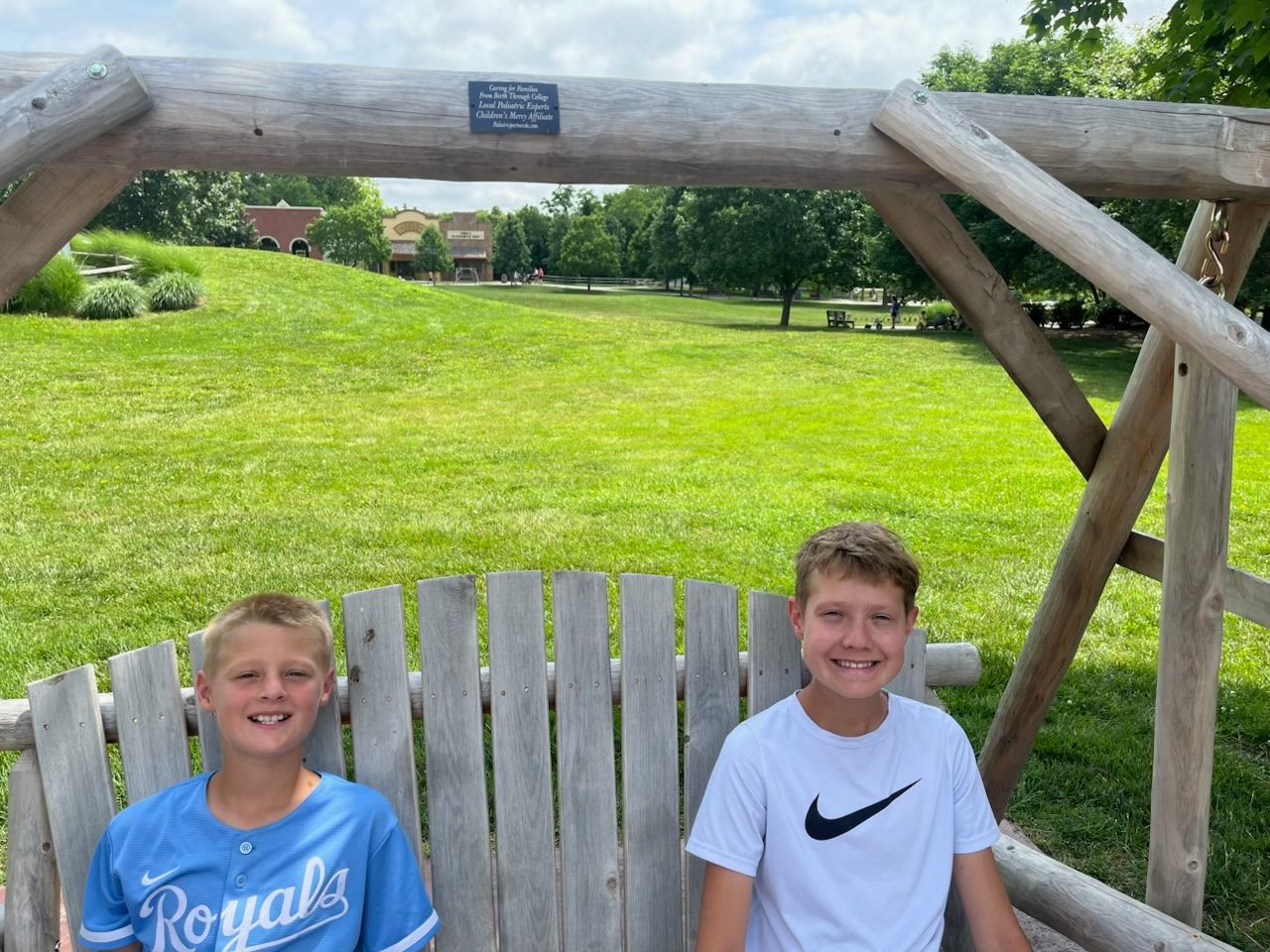
If your family visits Deanna Rose Children's Farmstead this summer, be sure to look for the Pediatric Partners bench swing near the cow pen. We donated this swing as a place for families to rest, connect, and enjoy a few moments together while exploring one of our community's favorite destinations.
We've loved seeing photos of children and families sharing laughs and making memories on the swing already! If you stop by, we'd love to see your pictures too—tag Pediatric Partners on social media so we can celebrate your visit.
As you enjoy all the adventures summer has to offer, this month's newsletter focuses on another important part of growing up: helping children build the independence and resilience they'll need to thrive both now and in the future.
NEW benefit for Kansans!
Kansans can now find immunization records in the Kansas vaccine portal from WebIZ!



Have you heard about the free lactation support group?
Pediatric Partners is partnering with Infant and Toddler Services to offer a free monthly lactation support group for breastfeeding mothers and their infants. Join us in a welcoming and supportive environment to connect with other families, learn practical breastfeeding tips, ask questions, and receive encouragement from experienced professionals.
Whether you are new to breastfeeding or looking for ongoing support, all breastfeeding mothers are welcome — you do not need to be a Pediatric Partners patient to attend, so share this with a friend in need.
If you missed the announcement, listen to Dr Khaleghi's quick video about the relatively new lactation support groups.

As parents, it's natural to want to protect our children from disappointment, frustration, and failure. We want to help when they're struggling, solve problems when they're stuck, and make life easier when we can. But one of the greatest gifts we can give our children is not a life free of challenges—it's the confidence and skills to handle those challenges themselves.
Independence and resilience don't develop overnight. They grow gradually through everyday experiences, opportunities to practice, and the support of caring adults who believe in a child's ability to learn and grow.
What Are Independence and Resilience?
Independence is the ability to manage responsibilities, make decisions, and complete tasks without excessive reliance on others.
Resilience is the ability to recover from setbacks, adapt to challenges, and keep moving forward when things don't go as planned.
These skills work together. Independent children gain confidence through experience. Resilient children learn that they can survive mistakes and disappointments. Together, these traits help children thrive at home, in school, and eventually in adulthood.
Why These Skills Matter
Children who develop independence and resilience tend to:
- Have greater confidence in their abilities
- Show better problem-solving skills
- Cope more effectively with stress and change
- Develop stronger executive functioning skills
- Take responsibility for their actions
- Become more prepared for future academic, social, and workplace challenges
Research consistently shows that children benefit more from learning how to overcome obstacles than from having obstacles removed for them.
Start with a Growth Mindset
Children often believe that abilities are fixed—you are either good at something or you're not. A growth mindset teaches that skills improve with effort, practice, and persistence.
Try replacing:
- "You're so smart!" with "You worked really hard on that."
- "I knew you'd get it right." with "You kept trying even when it was difficult."
- "Don't worry, I'll do it for you." with "Let's figure out how you can do it."
When children understand that mistakes are part of learning, they become less afraid of challenges and more willing to try new things.
Let Them Do What They Can Do
One of the most common barriers to independence is that adults often do things for children that children could learn to do themselves.
This might include:
- Packing school bags
- Keeping track of assignments
- Ordering food at restaurants
- Managing personal belongings
- Resolving minor conflicts with friends
- Communicating with teachers or coaches
While stepping in may save time in the moment, it also removes opportunities for learning.
Ask yourself:
"Is this something my child can do independently, with support, or with practice?"
If the answer is yes, consider stepping back.
Allow Developmental-Appropriate Responsibility
Children develop confidence by contributing and being trusted with meaningful responsibilities.
Young children can:
- Put away toys
- Feed pets
- Help set the table
- Sweep
- Put clothes in the laundry hamper
School-age children can:
- Make simple meals
- Pack lunches
- Help with household chores
- Tell a server what menu item they want
Teens can:
- Manage their schedules
- Make appointments with guidance
- Handle transportation planning
- Learn to manage personal finances - dividing money earned into how much to spend, save, and give to charity
- Take increasing responsibility for school and extracurricular commitments
The goal isn't perfection. The goal is practice.
If your child is not able to do what others their age can, offer more supports, such as written checklists, using pictures for children who are not strong readers. Put these in a highly visible area and celebrate when they check things off their list. If your child continues to struggle, schedule a visit with our behavioral health clinician to explore why.
Don't Forget the Lost Skill of Phone Communication

One important life skill that many children and teens are getting fewer opportunities to practice today is talking on the phone.
Texting, messaging apps, online scheduling, and social media have made communication easier in many ways, but they have also reduced the number of situations where young people need to speak directly with someone they don't know. As a result, many teens and young adults feel significant anxiety when faced with making a phone call.
The good news is that phone communication is a skill, and like any skill, it improves with practice.
Start Small
Young children can begin by making simple phone calls to grandparents, cousins, or family friends. These conversations help them learn basic skills such as:
- Greeting someone politely
- Starting and maintaining a conversation
- Asking and answering questions
- Ending a conversation appropriately
At first, they may need coaching or a parent nearby, but over time they become more comfortable speaking independently.
Gradually Increase Responsibility
As children get older, look for opportunities to let them handle real-world phone calls.
For example, middle school students might:
- Call a friend to coordinate plans
- Contact a coach with a question
- Leave a voicemail message
High school students can begin taking on more adult responsibilities, such as:
- Calling to ask about volunteer opportunities
- Contacting an employer about a job application
- Scheduling a haircut, oil change, or dental or medical appointments when appropriate
- Contacting a pharmacy about prescription refill procedures
Coach, Don't Rescue
Many parents find it tempting to make the call themselves because it is faster and easier. However, every call a parent makes on a teen's behalf is one less opportunity for the teen to build confidence.
Instead of taking over, help your child prepare:
- Discuss what they need to say.
- Write down key points beforehand.
- Practice through role-playing.
- Help them think about possible questions they may be asked.
Then encourage them to make the call themselves.
Building Confidence for Adulthood
Many young adults arrive at college or their first job having never independently scheduled an appointment, called customer service, or spoken with a professional on the phone. These tasks can feel overwhelming if they haven't had opportunities to practice.
Each phone call helps children develop:
- Communication skills
- Self-advocacy
- Problem-solving abilities
- Confidence interacting with unfamiliar adults
- Independence in managing everyday responsibilities
The goal isn't to eliminate technology—online scheduling and texting are useful tools. The goal is to ensure that children and teens also develop the communication skills they'll need when a phone call is the best or only option.
A simple progression from calling grandparents as a child to scheduling an oil change, medical appointment, or job interview as a teen can help prepare them for the many situations they'll encounter as independent adults.
Resist the Urge to Rescue

Watching children struggle can be uncomfortable. Yet productive struggle is often where the most learning occurs.
If you do the thing for them, you're implying that they can't do it. That's what they learn, even if it's not your intent.
When your child encounters a problem, instead of immediately providing the answer, try asking:
- "What have you tried so far?"
- "What do you think might work?"
- "What are your options?"
- "Who could help you with this?"
- "What can you learn from what happened?"
These questions encourage problem-solving and help children discover that they are capable of finding solutions.
Let Natural Consequences Teach
Natural consequences can be powerful teachers.
- If a child refuses to wear their coat, they will feel cold.
- If a child doesn't eat their meal, they will feel hungry.
- If a child leaves their bike outside, it may get stolen or suffer from weather-related damage.
- If a teen spends money on an impulse buy, they will be farther away from having enough to buy the thing they were saving for.
Of course, parents should intervene when safety, health, or significant consequences are involved. But many everyday mistakes provide valuable learning opportunities.
Children often learn more from experiencing consequences than from repeated reminders. Resist the urge to say "I told you so." That turns the experience into a head-butting contest rather than a learning opportunity. Kids are smart. They'll figure it out without you harping on it.
Normalize Failure and Setbacks
Many children today feel intense pressure to succeed. They may avoid challenges because they're afraid of making mistakes.
Help your child understand that setbacks are normal.
Share stories about:
- Times you made mistakes
- Challenges you faced growing up
- Skills that took practice to develop
- Goals that required persistence
When children see that successful adults also struggle, they learn that failure is not a sign of inadequacy—it's part of growth.
Teach Emotional Resilience
Building resilience doesn't mean ignoring emotions. It means learning to manage them.
When your child is upset:
- Validate their feelings
- Listen before solving
- Help them identify emotions
- Encourage healthy coping strategies
Try saying:
- "That sounds really disappointing."
- "I can see why you're frustrated."
- "It's okay to feel upset."
- "Let's think about what you can do next."
Children who learn to tolerate uncomfortable emotions are better equipped to handle future challenges.
Encourage Healthy Risk-Taking
Children build confidence when they try new things and discover they can handle uncertainty.
Risky play in early childhood — such as climbing, rough-and-tumble, or using adult tools — is essential for childhood development. It allows children to test their limits, which builds self-confidence, emotional regulation, and critical risk-assessment skills. This type of play actually helps prevent future anxiety and leads to lifelong benefits.
Healthy risks for older children and teens might include:
- Joining a new club
- Trying out for a team
- Speaking in front of a group
- Applying for a job
- Learning a new skill
- Making new friends
Success builds confidence, but so does surviving disappointment and realizing life goes on.
Focus on Progress, Not Perfection
Perfectionism can undermine both independence and resilience. Children who fear mistakes often avoid challenges altogether.
Celebrate effort, persistence, and improvement, not the success itself.
Notice when your child:
- Tries something difficult
- Keeps going after setbacks
- Takes responsibility
- Solves a problem independently
- Learns from mistakes
Progress may be slow, but every small step matters.
Independence Looks Different for Every Child
Some children naturally seek independence, while others need more support. Children with ADHD, anxiety, learning differences, or other challenges may require additional scaffolding and practice. If your child seems delayed in learning these skills compared to their peers, schedule a visit with our behavioral health clinician to explore why.
The goal is not to expect children to do everything on their own. The goal is to provide enough support for success while gradually transferring responsibility over time.
Think of yourself as a coach rather than a manager. Coaches provide guidance, encouragement, and feedback—but they don't play the game for their athletes.
Final Thoughts
Building independence and resilience requires patience. It can be tempting to step in, fix problems, and smooth the path ahead. Yet children become capable adults by facing challenges, making mistakes, and learning that they can handle hard things.
Every time you allow your child to solve a problem, recover from a setback, or take responsibility for a task, you send a powerful message:
"I believe in you. You are capable. You can figure this out."
That confidence—both yours and theirs—becomes the foundation for lifelong resilience and independence.
If you need more help, check out the Behavior Checker's section on Independence or call to schedule a visit to talk about why your child is struggling with independence.

Sign Up To Stay In Touch!
Our newsletter, Growing Together With Pediatric Partners, will be published twice a month. By signing up, you'll be the first to know about our latest office updates, exciting news, and healthy tips for families.
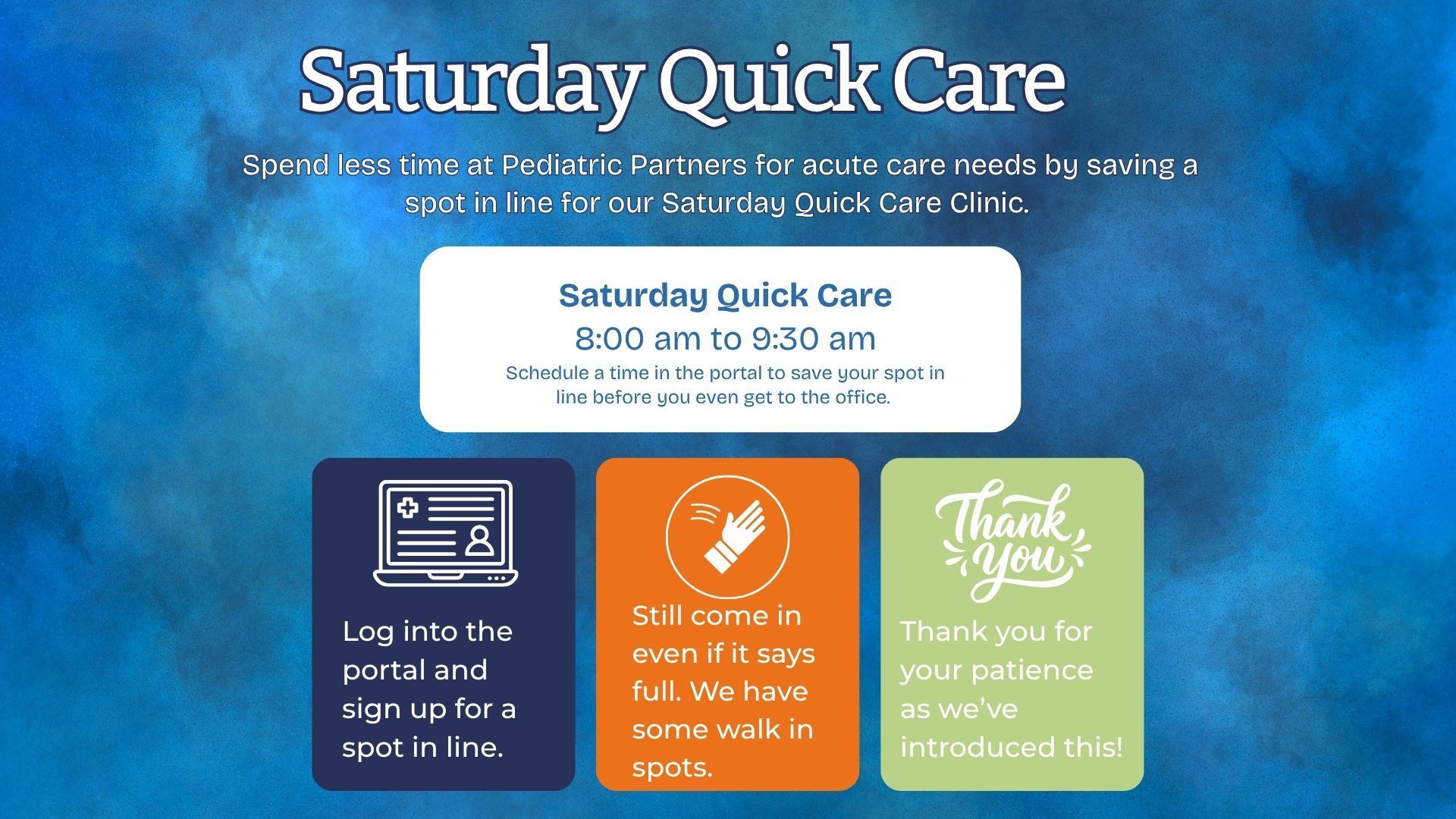
To reduce your wait time we are transitioning from a traditional walk-in model to a scheduled spot-in-line system, starting with our Saturday Quick Care Clinic.
How It Works:
- Reserve your place in line through our patient portal
- Arrive at your assigned time
- Be seen more efficiently
Important to know
- Urgent medical concerns (like breathing difficulty) always come first and may impact your waiting time.
- For active patients only (those who are up to date with their well visits).
- Quick Care is for illnesses and concerns that have developed in the past week (including concerns associated with a chronic condition like asthma) and minor injuries.
- Schedule with your usual provider for symptoms or conditions persisting longer than a week and behavior or mental health concerns. All routine follow up visits of a chronic condition (such as asthma, ADHD, anxiety) should be done with the person you usually see for that condition.
The following conditions are beyond our scope of care:
- Anaphylaxis - severe allergic reaction with severe difficulty breathing, hives, and sometimes vomiting - call 911. Use an Epinephrine autoinjector if available. We can see minor allergic reactions.
- Unconsciousness - go to an Emergency Room, preferably one for children.
- Broken bones that have broken the skin or with obvious deformity - go to an Emergency Room, preferably one for children.
- Ingestions of poisons - call Poison Control 800-222-1222.
- Suspected child abuse - see the "What to do if you suspect abuse" tab on this page if you want to learn more.
- Suspected rape - go to an Emergency Room, preferably one for children.
- Trauma to the eye that might involve a puncture to the eye, change in vision, or broken bones of the face (we can see possible scratches to the eye, which are most common) - go to an Emergency Room, preferably one for children.
- Burns of a large area of the body - call 911 and/or go to an Emergency Room, preferably one for children.
- Testing and treatment for sexually transmitted diseases - Limited testing is available in our office so call to see where the best location for your situation is.
- Anything that appears life threatening: call 911.
If there is here is a true medical emergency or life threatening condition, please call 911 or visit the nearest emergency room.
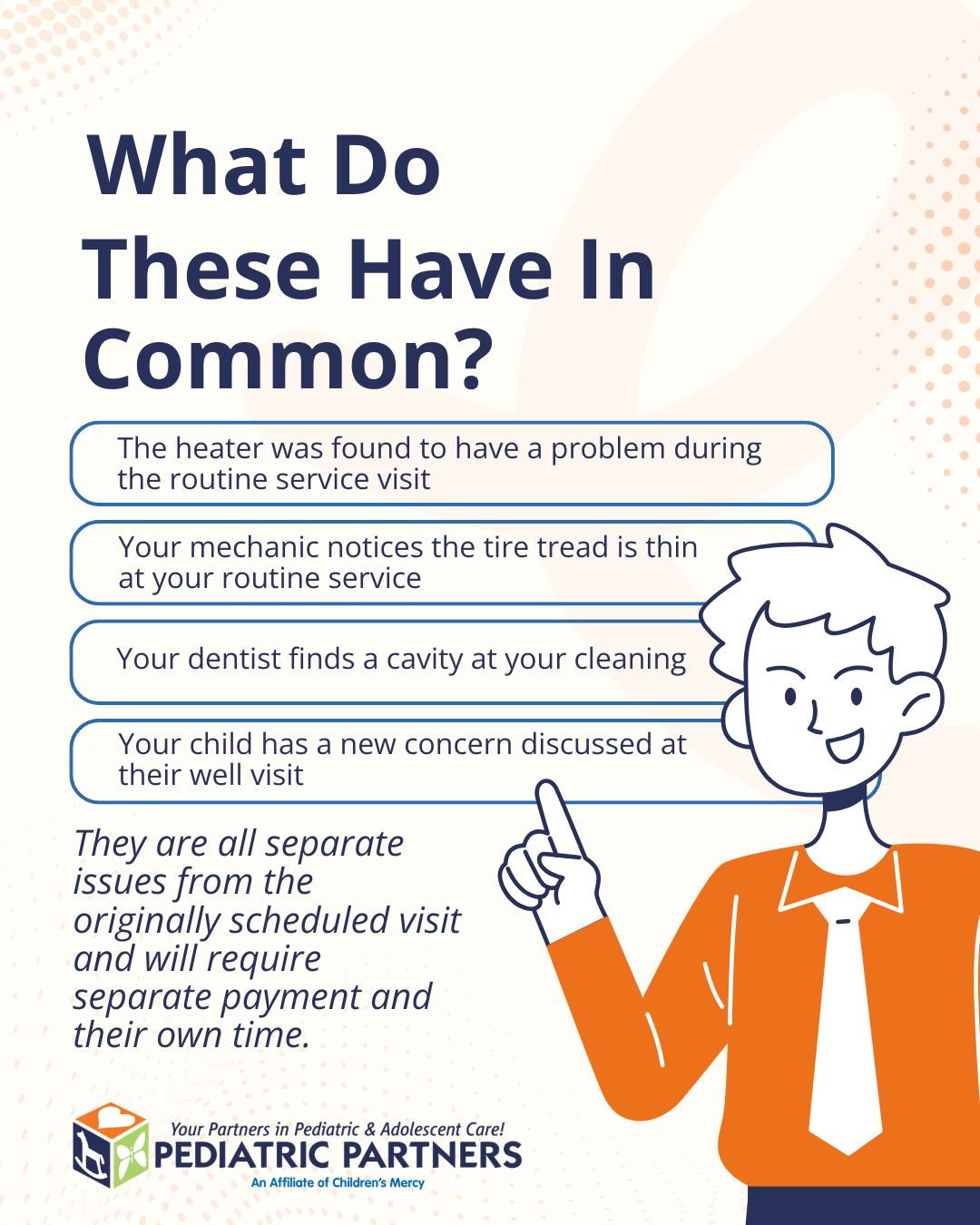
At your child’s well check, we love hearing how they’re growing, thriving, and changing. And if you bring up a new concern—an ear that’s been hurting, a rash that popped up, a medication issue—we’re always happy to help.
But here’s the part many families don’t realize:
When a new concern is addressed or a chronic condition is managed during a well visit, insurance requires us to bill an additional “sick visit” for that same day. This may lead to a copay or deductible.
⭐️ This is an insurance billing rule, not a Pediatric Partners policy.
Some concerns can be handled quickly during the well visit. Others—especially chronic, complex, or time‑intensive issues—need their own appointment so we can give your child the focused care they deserve.
If you’ve been holding onto a concern for months, please don’t wait for the annual check-up. Call us anytime to schedule a separate visit so we can address it sooner and more thoroughly.
We’re here to support your child’s health every step of the way.

Our offices will be closed on Saturday, July 4th, in honor of Independence Day. We will have normal business hours the Friday before and the Monday following the holiday.
As always, there is a person on call to answer the questions you cannot answer from the vast resources on this website.
What patient families say on Google Reviews

GINA SINHA RAY
Dr. Khaleghi is truly amazing.
Every staff member my husband and I have encountered has been kind, patient, and attentive with my child, always taking the time to listen and make sure we feel comfortable and understood. As a parent, that means everything to me. You can genuinely feel how much they care, and it brings such peace of mind knowing my child is in such good hands.
I’m so grateful we found them. Highly recommend!

tiffany burton
Nurse Shelby is our hero! My 10-year-old is terrified of needles and was stressed the morning of her appointment. Shelby was so patient, calm, and reassuring that my daughter got through both her finger poke and shot like a champ… no tears, no kicking, no screaming. By the end of the visit, she was even asking for Shelby again when we scheduled our next appointment.
I’m so grateful for the kindness and patience Shelby demonstrated. Experiences like this truly help build a child’s confidence and create a more positive attitude toward doctor visits and vaccinations in the future.

BEATA PESZAK
Dr Mellick always answers all our questions and has great approach to kids.
Pediatric Partners website has great additional resource for common questions and medication doses. I appreciate all treatment and recommendations are always based on most current medical knowledge.
Mrs. Loren was very helpful with taking test samples and showed lots of patience.
I strongly recommend this practice.