Depression Tips from Pediatric Partners
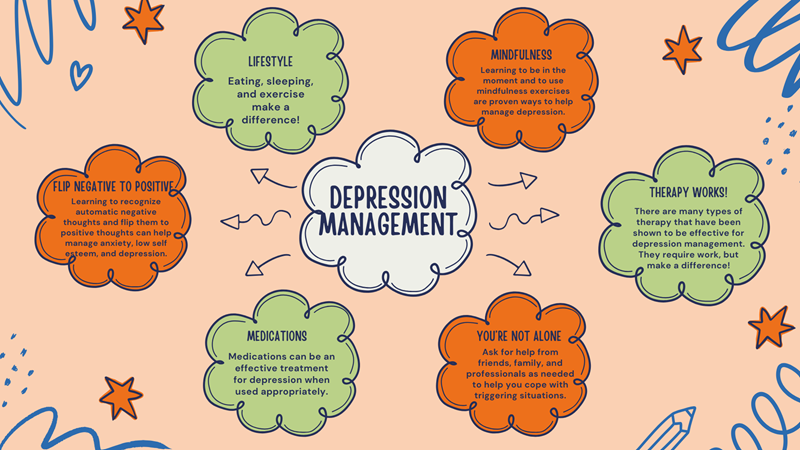
Depression is a common mental health condition characterized by persistent feelings of sadness, hopelessness, and loss of interest in activities. It often exists with related conditions, especially ADHD and anxiety. Effective management requires a holistic approach that addresses biological, psychological, and social factors contributing to the illness.
On this page (and others) you will find
- how we help you manage depression
- what schools can do
- general treatment information
- lifestyle interventions
- psychotherapy
- medications
- suicide risk factors and what to do if you suspect someone is struggling
- intensive outpatient and inpatient programs
- LGBTQ+ resources (because those who identify as LGBTQ+ are at risk for depression and suicide)
- Greater Kansas City Mental Health Resources - this community service group has resources for advocacy, insurance, and finding mental health services
- NAMI Family to Family free course to support families and friends with loved ones who struggle with mental health - you need support too!
- NAMI resources: support groups, crisis information, education, advocacy and more.
- Mental Health is Health has tips to use NOW when emotions are out of control. Also tips to help a friend if needed.
How Pediatric Partners can help you manage depression
We use an Integrated Behavioral Health system at Pediatric Partners. This integration uses a Social Worker for addressing immediate mental health needs and initiating therapy until a permanent therapist can be arranged as well as our pediatricians and nurse practitioners to provide medical management of prescription medications.
- The lifestyle changes and coping strategies below can be learned by children, teens, and adults. Our social worker can help with an initial assessment of symptoms and start therapy as indicated.
- To find local and online mental health professionals and additional resources, visit our Mental Health Resources page.
- For those on anxiety and depression medication, we require frequent visits until stable. It is recommended to follow-up with the prescriber every 3-6 months to make sure that things continue to go well and to discuss weaning off medications when appropriate. If medications are discontinued, follow up for several months is recommended to monitor for return of symptoms.
Patients should not stop medication without a plan from their prescriber. - For more information about managing anxiety, panic attacks, depression, and more, see our full Mental Health Toolkit.
- If our staff has consulted KSKidsMAP to help your child, please fill out this survey.

School Resources
Schools can be a fantastic resource when students are struggling with mental health. Talk to your school counselor to see what they can offer. Be sure to update them as symptoms change because it may change what they can do.
For more: Supporting Students with Depression in School (aap.org)
General Depression Treatment Information
Treatment of depression includes lifestyle changes, psychotherapy as well as pharmacotherapy (medication) when indicated.
See our Mental Health Toolbox for additional resources.
Lifestyle Interventions:
- Exercise: Regular physical activity has been shown to improve mood and reduce depressive symptoms by increasing endorphin levels and promoting neuroplasticity.
- Nutrition: A balanced diet rich in fruits, vegetables, whole grains, and omega-3 fatty acids may support mental health and reduce the risk of depression.
- Sleep Hygiene: Adequate sleep hygiene practices, including maintaining a regular sleep schedule, avoiding stimulants before bedtime, and creating a comfortable sleep environment, are essential for managing depression.
- Stress Management: Techniques such as relaxation exercises, mindfulness meditation, and stress-reduction strategies can help individuals cope with stressors and prevent exacerbation of depressive symptoms.
- Mindfulness and meditation have been shown to be effective in helping to reduce stress, anxiety, and depression. Meditation teaches you to pay attention to thoughts and feelings without passing judgment or having negative self-talk. Long-term consistent use changes the density of the grey matter of the brain. Science backs it up, so if you think it won't work, there's data to say otherwise.
- It takes time to develop a habit and mindfulness needs to be done daily - just a few minutes a day is all it takes to make changes, but you do need to do it regularly.
- There are many mindfulness and meditation apps out there.
- Common Sense Media has a meditation app review page that includes age suggestions for each. Some are for littles only, but others are appropriate for young children through adults.
- Balance is a newer app with a one year free trial - long enough to really develop your practice. It uses answers to daily questions to adapt your practice to your needs and explains the science behind why you do various exercises to help improve your learning. Try it! (We don't have any relationship with Balance, other than Dr. Stuppy has found it to be helpful getting her motivated to do mindfulness daily after years of knowing its benefits but finding it difficult to do.)
- Avoid Isolation: When we're alone we are left to our negative thoughts. Being around others can help keep our thoughts off the negative and enjoy the moment.
- Reflect on Good Things: Take a moment each day to reflect upon what you're thankful for and what went right in your day. Write these thoughts in a Gratitude Journal for even more reinforcement. With practice this becomes easier and more automatic and helps you have more positive thoughts in general.
- Be Kind: Doing things for others helps us too! Volunteer with a group or just do random acts of kindness when you see a person in need. These little things make a big difference for the person as well as for you!
Psychotherapy:
Psychotherapy is an important component of treating depression. There are several types that are evidence-based, including (but not limited to)
- Cognitive-Behavioral Therapy (CBT)
- Interpersonal Therapy (IPT)
- Behavioral Activation (BA)
- Mindfulness-Based Cognitive Therapy (MBCT)
The type of therapy is to be determined by the licensed therapist. Get help finding therapists from our Mental Health Professionals Page.
NAMI Family to Family
NAMI Family-to-Family is a free, 8-session educational program for family, significant others and friends of people with mental health conditions. It is a designated evidenced-based program. This means that research shows that the program significantly improves the coping and problem-solving abilities of the people closest to a person with a mental health condition.
Pharmacotherapy (medication):
Medications can be used along wtih psychotherapy to help boost neurotransmitters that help us feel better. They often help lifestyle changes and therapy work better and faster.
After a period of good mental health management, it is recommended to consider a trial off of medication under the direction of the prescriber, but stopping medication should never be done without guidance from them.
- Selective Serotonin Reuptake Inhibitors (SSRIs):
- SSRIs, such as fluoxetine, sertraline, and fluvoxamine, are first-line medications for pediatric depression and anxiety.
- SSRIs effectively alleviate symptoms by enhancing serotonin neurotransmission.
- Studies demonstrate their efficacy in reducing depression symptoms with tolerable side effects.
- While rare, potential adverse effects include tooth grinding, agitation, gastrointestinal disturbances, and very rarely an increase in suicidal ideation.
- Despite being in the same category, some people respond very differently to one or the other of these medications, so if one is not effective or not tolerated, it is recommended to try another.
- It can take several weeks to see a benefit of SSRIs and daily use is needed. Please be patient when starting a new medication.
- Never stop this type of medication without talking to your prescriber. Sudden discontinuation can cause significant withdrawal effects.
- Serotonin-Norepinephrine Reuptake Inhibitors (SNRIs):
- Venlafaxine, a commonly prescribed SNRI, is effective in treating pediatric depression and anxiety disorders. Its dual mechanism of action on serotonin and norepinephrine systems provides additional benefit for patients who do not respond adequately to SSRIs.
- Adverse effects include the risk of cardiovascular effects, withdrawal symptoms, and potential for serotonin syndrome.
- As with SSRIs, it is important to allow time for SNRIs to take effect.
- Sudden discontinuation can lead to adverse effects, so talk with your prescriber before making any change to the dose or discontinuing SNRIs.
- Tricyclic Antidepressants (TCAs) and Monoamine Oxidase Inhibitors (MAOIs):
- TCAs, such as imipramine and clomipramine, have demonstrated efficacy in pediatric anxiety and depression.
- MAOIs have been shown to be effective in pediatric depression.
- TCAs and MAOIs are reserved for cases refractory to SSRIs or SNRIs due to their significant side effect profile.
- Psychiatrists may use these medications, but our physicians and nurse practitioners do not prescribe them.
- Augmentation and Combination Therapies:
- For individuals with treatment-resistant depression, augmentation strategies involving the addition of atypical antipsychotics, or lithium as well as combination therapies with multiple antidepressants, may be considered by a psychiatrist.
Suicide risk factors & management
Many suicidal children and adolescents have clinical depression alone or in conjunction with another mental illness like anxiety disorder, attention deficit disorder, bipolar illness (manic depression), or child-onset schizophrenia.
Each child’s personality, biological makeup, and environment are unique, and depression and suicidal ideation in children are complex issues involving many factors. By recognizing and treating children we can improve the chances a young person with depression can live a longer, healthier, more quality life.
988 has been designated as the new three-digit dialing code that will route callers to the National Suicide Prevention Lifeline.
Parents can learn more from Project Hug - a youth suicide prevention program from the Jason Foundation.
KNOW WHAT TO WATCH FOR
Warning signs of suicide in children and teens may look like:
- SAYING THINGS LIKE ...
- "I shouldn't be here."
- "I'm going to run away."
- "I wish I were dead."
- "I'm going to kill myself."
- "I wish I could disappear forever."
- "If a person did this or that... would he/she die?"
- "The voices tell me to kill myself."
- "Maybe if I died, people would love me more."
- "I want to see what it feels like to die."
- "My parent's won't even miss me."
- "My boy/girlfriend won’t care anyway."
- DOING THINGS LIKE ...
- Talking or joking about suicide.
- Giving away prized possessions.
- Preoccupation with death/violence; TV, movies, drawings, books, at play, music.
- High risk behavior such as jumping from high places, running into traffic, self-injurious behaviors (cutting, burning).
- Having several accidents resulting in injury; "close calls" or "brushes with death."
- Obsession with guns and knives.
- Previous suicidal thoughts or attempts.
HIGH-RISK CHILDREN:
- Are preoccupied with death, and don't understand it is permanent.
- Believe a person goes to a better place after dying or can come alive after dying.
- Are impulsive - act without realizing the consequences of their actions. (This includes people with ADHD, which is associated with a higher risk of suicide than the general population.)
- Have no or little sense of fear or danger.
- Tend to have perfectionist tendencies.
- Truly feel that it would be better for everyone else if they were dead.
- Believe that if they could join a loved one who died, they would then be rid of their pain and be at peace.
- Have parents or relatives who have attempted suicide (modeling behaviors/genetic factors can be involved here).
- Are hopeless; feeling that things will never get better, that they will never feel better.
- May identify as LGBTQ+ (whether or not they've told anyone).
ATTEMPT OR SUICIDAL BEHAVIOR:
- Doesn't know why they're doing it, but feels unable to stop it.
- May not remember the attempt when it's over.
- Feels as if they were/are in a trance.
- May think they will be rescued.
- Acting out pain because of an inability to verbalize feelings.
- Increased impulsiveness and impaired judgment, perceptions and cognitive skills.
Healthy, non-impulsive children who talk about death or seem preoccupied after losing a friend or loved one, but have a clear understanding that death is final, and who are not depressed, are probably at a very low risk for suicidal behavior.
Typically, when asked about their own death, children most often state it will happen due to old age or getting sick when they’re old. Many suicidal children believe that when others die, death is final, but that if they die, their death is reversible. Vulnerable children and adolescents who may be under stress (internal or external) may have a change in perceptions of and feelings about death.
KNOW WHAT TO DO IF SUICIDE RISK IS IDENTIFIED
Because children aren't always able to understand and explain their feelings, as adults we must be more vigilant in understanding the ways depression and suicide manifest in children, and work to get them the help they need.
IF YOU THINK A CHILD MAY BE SUICIDAL, ASK QUESTIONS ABOUT SUICIDE LIKE, "DO YOU EVER ...
- have thoughts of hurting yourself?"
- feel so badly that you have thoughts of dying?"
- wish you could runaway or disappear?"
- wish you could go to sleep and not wake up?"
- have scary dreams about dying?"
TREATMENT:
If you suspect anyone is suicidal, call 988 or follow your suicide action plan if one has been developed with your therapist.
- Out-patient psychotherapy:
- Cognitive Therapy - teaches more positive thinking, coping skills and problem-solving
- Interpersonal Therapy - might teach children how to make friends
- Group Therapy - with others of similar age that have a depressive illness
- Family Therapy - works with the entire family and discusses various family dynamics
- Various supports at school.
- Various forms of play therapy, relaxation therapy, biofeedback, visualization.
- Antidepressant medications, stimulants if co-existing ADHD, also some types of alternative medicine.
- Hospitalization (in-patient, partial hospitalization, day-treatment) or intensive outpatient therapy
HOW TO HELP
- Educate yourself on childhood & adolescent depressive illnesses and suicide.
- Assure your child they can feel better, that suicidal thoughts are only temporary, and that there are people who can help them.
- Always take suicidal tendencies seriously and respond immediately.
- Know that early intervention is the key to successful treatment for children who suffer from depressive illnesses.
- Understand that treatment should be a team-approach including a psychotherapist, a child/adolescent psychiatrist, parents, relatives, caregivers, school personnel, friends, babysitters, neighbors and other significant people in the child's life.
LOCAL INPATIENT AND INTENSIVE OUTPATIENT SERVICES
- HCA Midwest /Research Psychiatric Center (inpatient and outpatient, 12 years through adult) 1-844-207-4511
- KU Mental Health - Marillac Campus (inpatient services for children) 913-547-3800
- Crittenton Children's Center (inpatient and outpatient services for children) 816-765-6600
- Camber Children's Mental Health Center
- Cottonwood Springs for 12 years and up
- Johnson County Mental Health (24 hour emergency services, children to adults) 913-268-0156
- Kids TLC (Inpatient and outpatient services for children, specializing in trauma) 913-324-3658
- Suicide.org: Suicide Prevention, Awareness, and Support 1-800--SUICIDE (784-2433) or 1-800-273-TALK (8256)
NAMI Family to Family
NAMI Family-to-Family is a free, 8-session educational program for family, significant others and friends of people with mental health conditions. It is a designated evidenced-based program. This means that research shows that the program significantly improves the coping and problem-solving abilities of the people closest to a person with a mental health condition.