ADHD Tips from Pediatric Partners
Attention-Deficit/Hyperactivity Disorder (ADHD) is a neurodevelopmental disorder characterized by persistent patterns of inattention, hyperactivity, and impulsivity that significantly impair functioning across multiple settings. Not recognizing or treating symptoms of ADHD can lead to significant lifetime risks but it is one of the most treatable mental and behavioral health conditions.
Commonly ADHD is associated with related conditions, especially tics, anxiety and depression. (See the linked pages for information about those issues.)
If you are starting a new medication, changing doses or a medication, or want to track side effects and benefits, use one of the Medication Tracker Sheets:
- Version 1 is best to track when you take multiple medications that affect your mood and focus.
- Version 2 is best to track when you are titrating different amounts of a single medication.
On this page you will find information about or links to:
- how we manage ADHD
- pharmacotherapy (medications)
- behavioral interventions at home and school
- psychosocial support
- related conditions
- Find local and online professionals (therapists,coaches and more) on our Mental Health Professionals Page.
- Visit Services --> ADHD to see how we manage ADHD (return to this page through the link under "After visit advice about ADHD")
- Outside of Pediatric Partners Dr. Stuppy teaches 8-12 year olds and their parents about ADHD and executive functioning through a fun and interactive course. Learn about TEACH Me ADHD here.
- Watch Dr. Stuppy's talk to the local CHADD chapter about managing medication side effects.
- Families Together provides assistance with early intervention, education, health care, transitions, and community resources to support the academic, behavioral, social, emotional, and mental well being of children, youth, and families in Kansas. https://familiestogetherinc.org/
- MPACT is Missouri's federally-funded Parent Training and Information Center. They empower families to advocate for themselves so that children with special education needs can reach their full potential in education and life - through support, training, and education. https://www.missouriparentsact.org/
How does Pediatric Partners manage ADHD?
- Our pediatricians and some of our nurse practitioners prescribe medications to treat ADHD.
- Our social worker collects information from the family, patient, and school and begins the diagnostic process as well as help initiate behavior training as indicated.
- Patients who use medication for their ADHD management must follow our ADHD Management Policy
Co-morbidities (related conditions)
Many people with ADHD also have other related conditions. It is estimated that 6 in 10 children with ADHD have at least one other mental, emotional, or behavioral disorder:
Pharmacotherapy (medications):
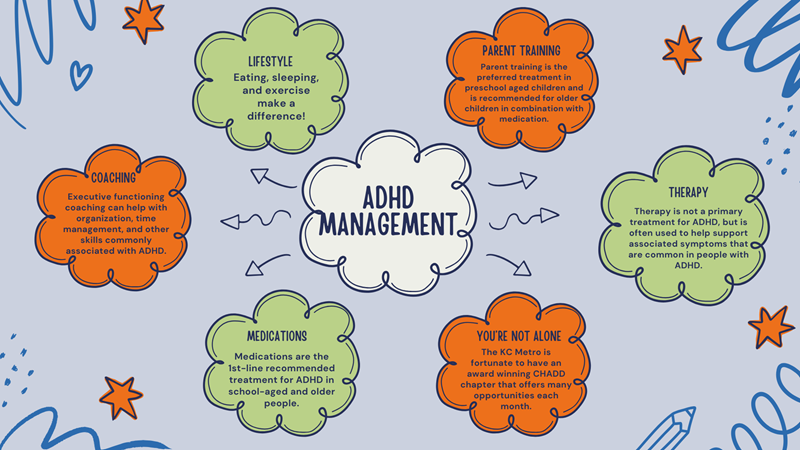
Medications are considered first line treatment for school aged and older people with ADHD when symptoms impact their daily lives.
Parents should keep these medications out of reach of children and should always supervise when children and early adolescents take these medications. Older adolescents should practice ways to remember their own medications, such as by using medication reminder apps or post-it notes.
When young adults move into college dorms or apartments, they should always keep their medications and other valuables in a locked safe - even if you trust your roommates. These have high street value, especially during times of medication shortages.
It is not recommeded to routinely do testing prior to starting medications.
- Clinical Use of Pharmacogenetic Tests in Prescribing Psychotropic Medications for Children and Adolescents - from the American Academy of Child and Adolescent Psychiatry:
- Clinicians should avoid using pharmacogenetic testing to select psychotropic medications in children and adolescents.
- Future high-quality prospective studies to assess the clinical significance of pharmacodynamic and combinatorial pharmacogenomic testing in children and adolescents.
- Types of medications:Stimulant Medications:
- Stimulants such as methylphenidate (ritalin) and amphetamines (adderall) are first-line pharmacological treatments for ADHD.
- Stimulants are controlled substances because they have street value, but have been used since 1955 to treat symptoms of what is now known as ADHD with overall great success and safety.
- Stimulants enhance dopamine and norepinephrine neurotransmission, improving attention, impulse control, and executive function.
- Common side effects of stimulants include appetite suppression during the time the medication is active, changes in sleep, and mood changes.
- These are often mild and some common management of side effects are discussed in this talk from Dr. Stuppy.
- If side effects are not tolerated, a change in dose or medication is recommended.
- Extended-release (ER) formulations offer sustained symptom control, usually a 6 to 10 hour period.
- Immediate-release (IR) formulations generally cover 3-4 hours and are often used to exend the period of control before or after an ER medication but can be used multiple times during the day without an ER formulation.
- Individuals respond to medications differently and if they do not respond to one of the formulations, they may respond well to another. Overall, about 80% of people with ADHD respond safely and effectively to one of the stimulant medications.
- Non-Stimulant Medications:
- Non-stimulant options like atomoxetine (Strattera), viloxazine (Qelbree), guanfacine (Intuniv, tenex), and clonidine (Kapvay) are used for individuals who do not respond well enough to stimulants and for those who do not tolerate stimulants.
- In general, non-stimulant medications are less effective than stimulants, but in some people they are preferred or used along with stimulant medications for optimal control.
- Off-label medications, such as bupropion (Wellbutrin), are sometimes used to manage symptoms of ADHD. These are medications that are approved for other uses and may benefit those with ADHD. Bupropion is an NDRI (norepinephrine and dopamine reuptake inhibitor). Norepinephrine and dopamine are two neurochemicals—chemicals that impact the nervous system—that can affect mood and focus.
- Guanfacine and clonidine
- Clonidine (Kapvay) and guanfacine (Intuniv, tenex), alpha-2 adrenergic agonists, are often used for ADHD and are sometimes used for pediatric anxiety disorders.
- Their effectiveness as a sole anxiety medication remains inconclusive so they are often used as add-on medication therapy.
- Adverse effects such as sedation and hypotension (low blood pressure) are generally found with initiating or increasing one of these medications but most people will adjust in 3-5 days. Extra salt and water may help this side effect.
- Do not stop this type of medication without talking with your prescriber because rebound hypertension (high blood pressure) can happen if it is suddenly stopped.
- Atomoxetine (Strattera) and viloxazine (Qelbree) are selective norepinephrine reuptake inhibitors (SNRIs). The way SNRIs treat ADHD isn’t fully understood, but it’s believed they work by raising levels of norepinephrine in the brain. Norepinephrine is a chemical messenger that’s important for many bodily functions, including focus and attention.
For more on medications used for ADHD management, see our ADHD Medication Page.
Behavioral Interventions:
- Parent Training:
- Parent training programs, such as behavioral parent training (BPT) and parent-child interaction therapy (PCIT), teach parents effective behavior management techniques and improve parent-child relationships, reducing disruptive behaviors in children with ADHD.
- Parent training is the first-line recommended intervention for preschool aged children with ADHD and as an accompanying treatment with medication for school aged children with ADHD.
- Recommendations for parent training are NOT done because you are a bad parent, they are done because parenting a child with ADHD requires different skills and strategies compared to parenting a neurotypical child. Learning these techniques can be most helpful for the entire family.
- School-Based Interventions:
- Collaborative efforts between educators, parents, and healthcare professionals can help create supportive learning environments tailored to the needs of students with ADHD.
- Classroom accommodations, behavioral interventions, and academic supports promote academic success and social integration.
- Cognitive-Behavioral Therapy (CBT):
- CBT is not a treatment for ADHD itself, but it targets cognitive and behavioral patterns that contribute to inattention, impulsivity, and emotional dysregulation.
- Organizational Skills Training:
- Executive function deficits are common in ADHD. Organizational skills training teaches individuals strategies for planning, time management, and task organization to enhance productivity and reduce functional impairments.
- Manage screen time:
- Online gaming and social sites are very attractive for the ADHD brain because these activities raise dopamine. Increaseed screen time has been associated with worsening of attention span and desired behaviors. Limiting screen time can be very difficult for parents. Dr. Sharon Saline has written about this and has a fabulous talk linked on the page that's worth your time.
- Healthy Screen Habits for Families
- The American Academy of Pediatrics (AAP) has a very helpful Family Media Plan tool. You can see suggestions based on age for all members of the family and adjust to your family's needs. See the AAP Media Plan Maker.
- Mindfulness and meditation have been shown to be effective in helping to calm the mind and improve focus. Long-term consistent use changes the density of the grey matter of the brain - areas of attention, emotional regulation, working memory and self-awareness benefit. Science backs it up, so if you think it won't work, there's data to say otherwise.
- It takes time to develop a habit and mindfulness needs to be done daily - just a few minutes a day is all it takes to make changes, but you do need to do it daily.
- There are many mindfulness and meditation apps out there.
- Common Sense Media has a meditation app review page that includes age suggestions for each. Some are for littles only, but others are appropriate for young children through adults.
- There are free apps, such as Smiling Mind and Insight Timer, that can help you practice mindfulness together. They each have child-specific meditations as well as ones for adults.
- Balance is a newer app with a one year free trial - long enough to really develop your practice. It uses answers to daily questions to adapt your practice to your needs and explains the science behind why you do various exercises to help improve your learning.
Psychosocial Support:
- Individual Therapy:
- Individual therapy sessions provide a safe space for individuals with ADHD to explore their emotions, develop coping strategies, and address comorbid mental health concerns such as anxiety or depression.
- Support Groups:
- Peer support groups offer individuals with ADHD an opportunity to connect with others facing similar challenges, share experiences, and provide mutual encouragement and understanding.
- ADHDKC is a KC Metro CHADD Chapter that offers separate support groups for parents, adults, women, and adolescents.
- Psychoeducation:
- Educating individuals with ADHD and their families about the nature of the disorder, treatment options, and coping strategies enhances treatment adherence and promotes self-management skills.
- Tools to help your child's teacher learn about ADHD