
7-8 year

Five people stand in a line posing for a photo in front of a modern, multi-colored glass building facade.

Some babies are born with a short frenulum under the tongue. This inhibits the baby from extending the tongue past the lips.


Many people refer to this condition as "tongue-tied" (medically called ankyloglossia).


The tongue’s frenulum attaches the tongue to the floor of the mouth. It should allow the tongue to extend past the lower gums and lip, elevate to the roof of the mouth, and move from side to side. If it is too thick, too short, or too far toward the tip of the tongue it can affect feeding, speech, tooth placement, and growth of the mouth. 


Not all frenulums that appear thick need to be treated. If the tongue functions well and the baby is feeding successfully, we do not need to do any procedures. Dr. Stuppy has written a summary of the guidelines recommended by otolaryngolosts (ear, nose, and throat specialists) on management of tongue, lip, and cheek ties that you can read here. 


Tongue tie affects about 4 in 100 people. It is more common in boys and there often is a family history of tongue tie.

  • Check your baby’s weight (we check length and head circumference too at standard well visits)
  • Ask about your baby’s feeding, bowel, and sleeping habits
  • Do a physical examination
  • Ask questions about development (in a pre-visit survey- watch for these texts before visits
  • Ask if you have questions or concerns about your baby
  • Update immunizations as recommended per our office schedule and standard guidelines

HOW IS IT TREATED?

We usually schedule the first visit 1-2 days after discharge. You will need to call to schedule this visit. Due to the nature of our scheduling availability, you may be asked to schedule with a member of our team that you have not yet met, but we think you'll like every one of our physicians and nurse practitioners. All have extensive training and experience and work well together to care for our patient families. 


After the first visit newborns usually have several weight checks to be sure they are feeding well and establishing good weight gain. After that, they follow the typical well visit schedule.

PHOTOS FROM STANFORD.EDU

Our physicians take turns seeing newborns in the hospital. You may get to see a face you already know or meet someone new, but we all trust our work teammates to take great care of our patients.

There are times that newborns require evaluation and care from a neonatologist (specialist in newborn care), such as if your baby is premature, has breathing difficulties, is suspected of an infection, or has need of intensive care. The local neonatologists will update us on how your baby is doing before they go home.

In the office

We see newborns at the following hospitals each morning:

WHEN THE TONGUE'S MOVEMENT AFFECTS FEEDING, A FRENOTOMY MAY BE RECOMMENDED

  • Infection
  • Bleeding (usually minor)
  • Swallowed blood can lead to spitting up
  • Damage to salivary glands (rare)
  • Need for more surgery
  • Feeding aversion

After the clipping the underside of the tongue will get a yellowed area (called "granulation tissue"). This is the normal healing tissue and will resolve within a few days.

What if your baby needs special care?

If you will be delivering at another hospital, just give us a call after you deliver to schedule your first visit. Please bring any paperwork given on discharge to your first visit. This may include your baby's birth weight, discharge weight, any lab values - such as bilirubin, screening results (such as hearing and cardiac screens) and any other information provided. This can help us learn about the hospital stay and continue care most effectively.

Newborns are scheduled to see one of our nurse practitioners or pediatricians for each visit. While we know that you will eventually see one of our staff primarily, initially it may be necessary to schedule with another person.

We all trust each other to work within our team, and newborns present the unique circumstance of needing a visit without much notice. Most of our routine well visits are scheduled 2-3 months in advance, so we hold spots for newborns, but it may not be with the person you will choose to see long term. We know this is not ideal because you want to introduce your baby to your chosen practitioner, but we cannot all have newborn spots open or it would cause scheduling issues for all the other patients - including your family long term. While we each have our unique personalities and bedside manners, we all follow standard care guidelines and will take great care of your little one!

If you want to learn more about us, check out the 
videos we have from each of our pediatricians, about our office locations, general medical advice we give and more.

Learn about each of the 
physicians and nurse practitioners on our individual pages.

  • Work with lactation to improve latch
  • Work with a speech pathologist or occupational therapist for feeding therapy

Kansas and Missouri each have routine newborn screens that are done in the hospital or birthing center to identify conditions that can be dangerous when not treated but not easily identified on a physical exam alone. The goal is to identify and treat diseases early enough to prevent serious complications such as growth problems, developmental delays, intellectual disabilities, blindness, deafness, and seizures.

You can learn more about the screenings from:

Risks of clipping:

Treatment of tongue tie involves lifting the tongue and clipping the frenulum (frenotomy).

A frenotomy can be done by trained pediatricians, ENTs, or dentists. Some of our pediatricians have this training, so if you're concerned we can make sure you get scheduled with one of them for an evaluation. ​There are local dentists who do a laser procedure, but this is more expensive and has not been shown to offer any benefit. (See Dr. Stuppy's review of guidelines for more details.)

​The frenulum does not have nerves for pain, and most newborns tolerate the procedure well without any anesthetic. We usually ask that they feed immediately after the procedure to assess their feeding. 

It is recommended if the frenulum is very thick, posterior, very vascular or if there is a family history of bleeding disorders that an ENT specialist does the procedure.

We work as a team at Pediatric Partners - from the front desk receptionists, to our nursing staff, to our nurse practitioners and pediatricians, we're all here to take the best care of your family!

  • Advent Health -Shawnee Mission
  • Overland Park Regional Medical Center

In the hospital

Most of the time we can start our relationship at the hospital when we see your baby soon after birth, but sometimes we begin care after they are discharged from the hospital. We generally see babies in our office 1-2 days after they are discharged from the newborn nursery or NICU.


If you choose our office, be sure to let the hospital know who your pediatrician will be. The hospitals call us after the baby is delivered and we will see you each morning.


One of our physicians will round each morning in the hospital to check on your baby, see how feeding is going, and treat most problems that arise. Most babies are in the hospital 2-3 days and we see them on daily rounds to evaluate how they are feeding, how much weight loss they have, perform a physical exam, and discuss parental concerns.


As mentioned above, we work as a team. Our pediatricians take turns rounding each day, so you may meet several of us during your stay at one of the above hospitals and it may not be the pediatrician you plan to see long term in our office, but we will be sure that person hears all about your baby. 

What if you're delivering somewhere else?

We occasionally care for babies in the Newborn Intensive Care Nursery (NICU) if they are there for a short time and for minor issues.

We have a relationship with the Neonatologists (specialists in sick and premature newborn care) at each of the hospitals. They help care for the infants who are requiring more specialized care and let us know when they're ready to see us.

Alternates to frenotomy:

During the visit we will :

A newborn with a noticeable tongue-tie, characterized by a short, tight lingual frenulum restricting tongue movement.
Close-up of a newborn with an open mouth, showing the tongue and gums.

The pictures are the same baby before and after the frenulum was clipped.
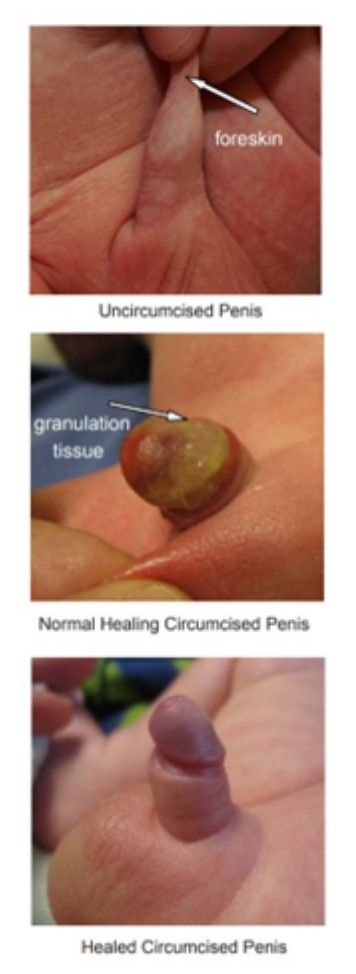
Three panels showing an uncircumcised penis, a healing circumcised penis with granulation tissue, and a healed penis.

PROCEDURE DESCRIPTIONS

MOGEN CLAMP:

The type of procedure done is dependent on the training and experience of the person performing the procedure. Risks and benefits overall are similar. The final "look" of the penis will be the same after the first week.

Both types use a local anesthetic called lidocaine to numb the area. This injection may sting initially (sugar and a pacifier are used to help pain control for the sting) and the injection may leave a bruise at the base of the penis. Babies can still feel the cold of the cleaning product we use to decrease risk of infection and they can still feel tugging, but the sharp pains of the procedure are lessened with the lidocaine. The foreskin is pulled away from the head of the penis (aka glans). 

The remainder of the procedure done and aftercare depends on the type of circumcision.

There are two main types of circumcision, one that leaves a plastic ring (Plastibell) on the head of the penis, and another that removes the foreskin and is left open with petrolatum jelly on gauze.

Care depends on the procedure done. After a baby's circumcision, it takes about a week to heal regardless of the method used. 

After the healing has taken place, no special care is needed other than routine cleaning.

We recommend putting petroleum jelly on the head of the penis during the healing process to keep it from sticking to the diaper. If stool gets to the area, simply rinse with water without rubbing the area much. Reapply petroleum jelly each diaper change. We suggest you do not use any creamy products or lotions on the healing penis, as they cause irritation. 


  • The foreskin is pulled up and the clamp is placed over the glans, to protect it from being cut.
  • The clamp puts pressure on the tissues to prevent bleeding.
  • The foreskin above the clamp is removed.
  • No stitches are needed unless there is excessive bleeding, which is a rare complication.
  • The head of the penis will look open and raw during the healing process. This is normal!
  • Change the gauze pad with petrolatum jelly (Vaseline) with diaper changes since it will be soiled. 
  • Rinse the head of the penis with water if stool (poop, bowel movement, meconium) gets on it, but usually simply changing the gauze is sufficient.
  • Continue to place Vaseline gauze on the head of the penis until it is healed. You will know when it is healed when there are no more red or yellow areas.
  • If there are signs of infection, such as redness of the penis shaft, temperature over 100.4F, poor feeding or fussiness, your baby should be evaluated.

Sometimes the penis will sink into the fat pad surrounding it, allowing the skin to reattach over time.


If your child's foreskin comes back over the head of the penis, push back on the fat pad to pull the skin off the head of the penis with diaper changes. Apply petrolatum jelly (Vaseline) to the area to prevent sticking.

If it does stick, it is called an adhesion. This usually doesn't cause any problems - remember that uncircumcised penises generally pull away from the foreskin over the pre-pubertal years. The adhesions of a circumcised penis will also naturally pull away over time. If they cause pain, they should be addressed. 

A white substance called smegma sometimes is seen around the edges of the head of the penis. This looks like cottage cheese and is sometimes mistaken for pus. It is not pus and is a normal substance made by the penis. Gentle removal with a moist cloth is all that's needed if it's bothersome.

Circumcision types and care

The foreskin is attached to the head of the penis at birth and will usually naturally pull away over the first few years of life. A white substance may be seen as the foreskin pulls back. This is smegma and normal, not a sign of infection.

As long as the foreskin doesn’t easily retract, only the outside skin needs to be cleaned.


If the foreskin retracts a little, clean only the exposed area with water. Don’t use soap on this area - this can irritate the skin. After cleaning always replace the foreskin back over the head of the penis. 


As your child gets older and the foreskin has completely separated and retracts easily, begin to teach him to clean underneath it as he bathes. 


If the foreskin does not naturally pull away from the head of the penis an this causes painful erections, bring your child in for an evaluation of the situation.

Uncircumcised penis

A WORD ABOUT ADHESIONS...

After the Mogen Clamp it will look bright red and swollen initially, then less swollen. As it heals, yellow granulation tissue appears on the head of the penis. This is normal and NOT an infection. 

PLASTIBELL

  • A plastic ring (Plastibell) is inserted between the head of the penis and the foreskin and tied off.
  • The ring is left in place until it falls off naturally, generally 3-7 days later. 
  • Routine cleaning with diaper changes is done.
  • If the ring does not fall off within 14 days or if it slips down the shaft of the penis, bring your baby in to be evaluated. This is an emergency if it seems red, tender, or your baby has a temperature over 100.5F, is fussy or not feeding well.
  • Track your child's development with FREE online tools
  • Find developmental milestone information so you can keep track at home.
  • Pathways offers resources for infant and child development.
  • Zero to Three offers resources for infant and child development and parenting.
  • Did you know you can sign up for free weekly texts coinciding with your due date to help with every stage of pregnancy and the baby's first year? Visit text4baby for more details. 

Milestone Tracking and Tools to Maximize Your Child's Development

Childcare can be done in a person's home or in an established child care center. There are pros and cons to each, so consider your family's needs to start your search. 

ChildCare Aware has a searchable database to help locate childcare providers, check licensing of childcare providers and see inspection reports. Click on the state to find providers in 
Kansas and Missouri.

To help locate a childcare provider, learn how to find the best childcare, and more use this searchable database: 
Childcare.gov. Use their Tip Sheets to help find the best care for your child(ren).

Local Resources to Optimize Development

  • Parents As Teachers works with parents to teach them how to teach their infants through 3 year olds. 
  • Infant and Toddler Services provides therapies for Kansas infants and toddlers through 3 years of age with delays in developmental skills, such as speech and language or gross motor skills. 
  • First Steps provides therapies for Missouri infants and toddlers through 3 years of age with developmental delays.

Daycare:

Colic (Fussy baby) Resources:

Hot Topic: Sleep & Screens

Ensuring your child gets enough sleep is crucial for their overall health, development, and well-being. Likewise, managing screen time effectively plays a significant role in promoting healthy sleep habits.

Importance of Sleep for Children:

  • Physical Health: A good night's sleep is essential for physical growth and development, as well as maintaining a healthy immune system.
  • Cognitive Function: Sleep plays a vital role in cognitive processes such as memory consolidation, attention, and problem-solving skills.
  • Emotional Regulation: A lack of sleep can contribute to moodiness, irritability, and difficulty managing emotions.
  • Behavioral Regulation: Children who don't get enough sleep may exhibit behavioral challenges such as hyperactivity, impulsivity, and difficulty concentrating.
  • Overall Well-being: Adequate sleep contributes to a child's overall well-being, including their ability to learn, interact with others, and navigate daily activities successfully.

Screen Time Management:

  • Set Limits: Establish clear guidelines for screen time, including limits on the amount of time spent watching TV, playing video games, or using smartphones and tablets.
  • Create Tech-Free Zones: Designate certain areas of the home, such as bedrooms and dining areas, as screen-free zones to promote healthier sleep habits.
  • Establish a Bedtime Routine: Create a consistent bedtime routine that includes calming activities such as reading, storytelling, or listening to soft music to help your child wind down before sleep.
  • Limit Screen Time Before Bed: Avoid screen time at least an hour before bedtime, as the blue light emitted by screens can interfere with the body's natural sleep-wake cycle and make it harder for children to fall asleep.
  • Model Healthy Behavior: Be a positive role model by managing your own screen time and prioritizing quality sleep for yourself.
  • 5 C's: Consider how screen time will affect your child's development by asking the 5C's - with age-specific advice.
  • Smart phones affect sleep and safety: There are many risks to smartphones in young hands. Wait Until 8th pledge empowers parents to rally together to delay giving children a smartphone until at least the end of 8th grade. There are several local elementary and middle schools participating - and if yours isn't, you can get it started! Banding together helps decrease the pressure to have a phone at an early age. Learn more and take the Wait til 8th Pledge: Wait Until 8th
  • Family Media Plan: The AAP's Family Media Plan tool to help families establish healthy screen time habits. Here are some key components of the plan:
  • Media-Free Zones: Designate specific times and areas of the home where screens are not allowed, such as during meals or family gatherings.
  • Screen Time Limits: Set age-appropriate limits on the amount of screen time allowed each day, taking into account factors such as age, developmental stage, and individual needs.
  • Quality Content: Encourage the use of high-quality, educational media that promotes learning and creativity while avoiding excessive exposure to violent or inappropriate content.
  • Bedtime Guidelines: Establish consistent bedtime routines and limit screen time before bed to promote better sleep hygiene.

Feeding & Nutrition

  • Aim to include a fruit or vegetable plus a protein each time your child eats. This helps reach the “5-a-day” fruit/vegetable goal.
  • Teach your child about balanced meals by providing healthy options and letting them decide how much to eat. This supports intuitive eating.
  • Limit juice—it’s mostly sugar and provides little nutrition.
  • Keep sugary snacks to a minimum; save desserts for special treats.
  • Use low-fat milk, but limit to 24 oz/day. Too much can crowd out other nutrient-rich foods and cause vitamin and iron deficiencies.
  • All children need a vitamin D and iron supplement. [Learn more about vitamin D.]
  • Encourage kids to serve themselves and help prepare food. This builds independence and often helps picky eaters try new foods.

Health & Safety

  • Children this age get 8–12 viral infections per year. Each may last 2–3 weeks, so it can feel like they’re always sick, especially in cold/flu season.
  • Staying up to date on seasonal vaccines can help prevent serious infections.
  • ASK (Autoimmunity Screening for Kids) is a free, research-based program that screens for T1D and celiac disease.
  • For people 1 to 99 years old
  • No family history of T1D required
  • No current or past diagnosis of diabetes
  • Visit AskHealth.org to learn more.
  • Secondhand smoke and daycare exposure increase infection risk.
  • Fever (100.4°F or higher under the arm) is a normal response to illness. Treat only if your child is uncomfortable.
  • Begin routine care with a pediatric dentist if you haven’t already.

Growth & Development

  • Puberty may begin as early as:
  • Girls: breast budding at 7–13 years; periods usually start about 2 years later.
  • Boys: testicle enlargement at 9–14 years.
  • Growth in height/weight speeds up just before and during puberty. Extra sleep and healthy nutrition are especially important!
  • Begin conversations about body changes now—before they start.
  • Encourage healthy sleep routines. Ask us if your child struggles with falling or staying asleep.
  • Bedwetting is still normal at this age. Never punish—ask us about strategies if it’s a concern.
  • Teach decision-making skills by allowing natural consequences when safe.
  • Watch shows or read books together—talk about choices, behavior, and consequences.

Safety Tips

  • Adults should model safe behavior: wear helmets and seatbelts, avoid smoking or vaping, and drink alcohol responsibly.
  • Apply sunscreen 30 minutes before outdoor play and reapply it every 2 hours.
  • Use DEET insect repellent as needed, but avoid combo sunscreen/bug sprays.
  • Kids should wear a helmet and closed-toe shoes (like tennis shoes) for biking, skating, or scootering.
  • Begin age-appropriate conversations about tobacco, alcohol, sex, and drugs. Ask what your child has heard from friends or media, and build from there.
  • Guns should always be locked and unloaded, with ammunition stored separately.
  • Teach your child basic first aid.
  • ​Keep your child’s environment tobacco- and vape-free. No smoking in the house or car. If you need help quitting, see Kansas Quit.
  • Monitor screen use—set limits on time, and guide what’s safe to see and share. If your child gets a cell phone, consider starting with limited features until they are ready.

Car & Home Safety

  • Use a belt-positioning booster seat until the seatbelt fits properly (about 4’9” and 8–12 years old).
  • Children should ride in the back seat with a seatbelt until at least 13 years.
  • In a booster seat:
  • Lap belt should sit low across the thighs.
  • Shoulder belt should cross the center of the chest and shoulder, not the neck or face.
  • Always wear your own seatbelt—kids learn by example.
  • Never drive while impaired or distracted (drugs, alcohol, texting).
  • Never smoke or vape in the car—even without kids inside. Thirdhand smoke lingers in the space.
  • Check smoke and carbon monoxide detectors regularly.
  • Parents should refresh CPR training every 2 years. Search “CPR” plus your ZIP code for local classes.
  • Always leave contact information with babysitters. See our Babysitter Reminders Page for more.

Looking Ahead

  • Annual well visits are for prevention.
  • If there are ongoing concerns, please schedule a separate visit to dedicate the appropriate amount of time to evaluate these issues.
  • If you or a teacher has concerns about behavior or development, please schedule a separate visit.
  • At your child’s next visit, we’ll talk about:
  • Caring for your child, your family, and yourself.
  • Growth, development, and school progress.
  • Social-emotional health.
  • Vaccines:
  • HPV vaccine can be given starting at age 9. It helps prevent cancers caused by HPV in both men and women. Best protection comes before the teen years.
  • We will also offer seasonal and catch-up vaccines as needed.
  • Review which vaccines your child may need on our immunization pages before the visit so you can have your questions ready!

✅ Planning ahead: Middle and high schools in Kansas require sports physicals to be completed after May 1st but before the season. If your child does annual well visits outside the summer months, start adjusting by 3 months at a time to get to a summer schedule. ​


Resources

Some pages you might find helpful at this age include:

Feeding & Nutrition

  • Try to give a plant (fruit or vegetable) plus a protein each time your child eats. This helps them get to the 5-a-day fruit/vegetable recommended intake. 
  • Teaching your child about balanced meals and snacks is a great way to promote healthy eating. You can do this by providing healthy options, like fruits and vegetables, throughout the day. Let your child decide how much to eat. This helps them eat intuitively and have control over their food.
  • Limit juice and minimize sugary snacks. Juice offers little nutrition and has a lot of sugar! 
  • Low-fat milks are appropriate. Limit to no more than 24 oz. daily. Too much milk is dangerous because it fills kids up and they don’t eat other nutrient rich foods, leading to deficiencies in other vitamins and iron.
  • All children should receive a supplement of vitamin D and iron because they do not get enough in their diet. Learn more about vitamin D.
  • Let kids help serve themselves and prepare food - this helps them develop their skills and often times helps picky eaters increase their food intake!


Health & Safety

  • Kids get 8-12 viral infections per year. Each may last 2-3 weeks, so they seem like they're always sick, especially during the cold and flu season. Visit our illness pages as needed.
  • Smoke exposure and day care increase risk of viral infections.
  • Fever (temperature more than 100.4° F. under the arm) is the body’s response to illness. It can be a good thing by helping to eliminate infection. Treat only if uncomfortable.
  • It is time to establish care with a pediatric dentist if you haven't already. Check your insurance to see who is covered.
  • Teach how to make good decisions. Let kids learn from natural consequences as much as possible.
  • Watch shows together or read the books your child reads and talk about character choices and behaviors in addition to consequences.
  • Puberty can begin as early as 7 for girls and 9 for boys. The 1st noticible physical sign in girls is usually breast budding at 7- 13 years. Menstruation usually starts 2 years after the onset of breast changes. In boys, the 1st physical change is enlarging testicles at 9- 14 years. Growth in height and weight is very rapid just before and during puberty. Begin talking with your child about body changes now, before it’s too late!
  • Children learn by example: Adults should wear helmets and seat belts. Never smoke or vape in front of your child. Never drink alcohol to excess in front of your child.
  • Apply sunscreen 30 minutes before going out and re-apply every 2 hours. Bug sprays with DEET are recommended when exposed to insects. Don't use combination products.
  • Use a helmet and tennis shoes whenever on bikes/skates/etc!
  • Talk about tobacco, alcohol, sex, and drugs in a way your child can understand. Remember they hear about these from screens and friends, so ask what they know and go from there.
  • If you own a gun, keep it unloaded and locked. Keep the ammunition locked separately.
  • Learn how to monitor what your child sees online and talk about how to use screens appropriately and safely - both in time spent online and what is being seen and shared. If your child gets a cell phone, consider one with limited online capabilities until they're mature enough to manage it safely.
  • Kids should learn basic first aid.
  • Continue healthy sleep habits and routines. If your tween struggles with sleep (or waking up), ask us for tips.
  • Bedwetting is related to deep sleep and can still be normal in this age group. If it is a problem for your child, talk to us about ways to manage it. Never belittle your child for accidents! It is not within their control.
  • If your child struggles with emotional regulation, following directions, or other mental or behavioral concerns, schedule a visit to discuss in detail.
  • 988 is a Suicide Prevention hotline. Teach it to your kids! You'd be surprised how young they might think that they would be better off not being alive. 
  • If you are worried about your living or food situation, talk with us. Community agencies and programs such as WIC and SNAP provide information and assistance. Find information about this and more on our Community Resources Page. See the "Economic and Financial Help" tab.
  • Ask us for help if you have been hurt by your partner or another important person in your life. Hotlines and community agencies like Safehome can also provide confidential help. 
  • Tobacco-free spaces keep children healthy. Don't smoke or use e-cigarettes. Keep your home and car smoke-free. If you need help quitting, find information on our Community Resources Page.
  • Car safety:
  • Use a belt-positioning booster seat until the vehicle lap and shoulder belt (adult seat belt) fits properly, typically 4 feet 9 inches in height and between 8 and 12 years of age.
  • Kids should use a belt-positioning booster seat in the back seat of your vehicle — always with the vehicle lap and shoulder belt. No one except teens and adults should sit up front!
  • When using a booster seat, make sure the lap belt lies low and snug across your child’s upper thighs, below the hip bones. The shoulder belt crosses the center of your child’s chest and shoulder and not cut across her neck or face.
  • Always wear your lap and shoulder seat belt to better protect yourself in case of accident. This also shows your kids that you are being safe. Kids do what they're shown more than what they're told - they're always watching you to learn!
  • Never drive after drinking alcohol or using drugs.
  • Never text or use a cell phone while driving.
  • Do not smoke or vape in the car - even if children aren't in the car, it is an enclosed space and your child will be exposed to third hand smoke or vaping chemicals.
  • Check your smoke and carbon monoxide detectors and replace batteries regularly.
  • All parents should learn CPR and refresh skills every 2 years. For a list of CPR classes for both non-medical and medical professionals, search for "CPR" with your zip code on a web search engine.
  • Always leave contact information with babysitters. For more babysitter tips, see our Babysitter page.

Looking ahead to the next year's visit:

We'll talk about

  • Taking care of your child, your family, and yourself.
  • Any questions related to growth and development that you have.
  • How school is going and any concerns with social emotional development.
  • Starting at 9 years of age we offer the HPV vaccine. This is an important vaccine that can help to prevent cancer in men and women. Giving the vaccine before exposure to the virus that causes these cancers protects children for the future. The vaccine can be given between 9 and 45 years, but it works best before the teen years. We will offer seasonal or catch up vaccines as indicated. 
  • Review the vaccines we'll give before your visit.