Welcome to Summer

May 21, 2026
Wishing you a safe and meaningful Memorial Day weekend!
As we head into the unofficial start of summer, we hope you enjoy time with family, sunshine, and a little extra rest. We also pause to honor and remember the service members who gave their lives for our country.
Our office will be closed on Monday in observance of the holiday. We’ll reopen on Tuesday, ready to care for your families. As always, our triage line is open for your urgent needs that cannot be found within our website's helpful resources.
Have a safe, relaxing holiday and a wonderful summer kick‑off.
School's out — which means more time outdoors, travel, and adventure for your family. At Pediatric Partners, we want every child in our practice — from your newest newborn to your college-bound teen — to have a safe and healthy season. Here are our top tips to make this summer the best one yet.
☀ Sun, Water & Heat Safety
Sunscreen & Sun Protection
• Use SPF 30 or higher broad-spectrum sunscreen on all exposed skin — reapply every 2 hours and after swimming or sweating.
• Babies under 6 months: keep them out of direct sun entirely. If unavoidable, minimal SPF 30 mineral sunscreen on small exposed areas is acceptable.
• Dress kids in lightweight, long-sleeved shirts and wide-brimmed hats whenever possible.
• Seek shade during peak UV hours: 10 a.m. to 4 p.m.
Water & Pool Safety
• Never leave a child unattended near water — not even for a moment.
• Designate a "water watcher" at every pool or beach gathering — one adult whose only job is watching the water.
• Life jackets (Coast Guard-approved) for boats and open water. Arm floaties are not safety devices.
• Swimming lessons are one of the most important safety investments you can make, even for toddlers.
• Hot tubs: children under 5 should avoid them entirely; older kids should limit time due to overheating risk.
Heat & Hydration
• Never leave a child in a parked car — temperatures can become dangerous within minutes, even with windows cracked.
• Encourage frequent water breaks — kids may not feel thirsty until they're already dehydrated.
• Signs of heat exhaustion: heavy sweating, cool/pale/clammy skin, fast weak pulse, nausea, muscle cramps. Move to a cool area and hydrate immediately.
• Signs of heat stroke (a medical emergency): high body temp (103°F+), hot/red/dry skin, rapid strong pulse, possible unconsciousness. Call 911.
For more tips on keeping your family protected, visit our Safety resources page.
👶 Age-by-Age Summer Guide
Summer fun looks different at every stage. Here's what to keep in mind for your child:
Newborns & Infants (0–12 months)
• Keep babies out of direct sunlight — shade, hats, and light clothing are your best tools.
• Heat regulation is immature in newborns; watch for signs of overheating (flushed skin, rapid breathing, no tears when crying).
• Breastfed babies don't need water supplements in the heat — breast milk or formula is sufficient hydration.
• Travel internationally? Schedule a pre-travel visit with us — even infants may need vaccines depending on destination.
Toddlers & Preschoolers (1–5 years)
• Water tables, sprinklers, and small pools are wonderful — but constant adult supervision is non-negotiable.
• Sunscreen should be part of the morning routine before any outdoor play.
• Carry water everywhere and offer it frequently — toddlers get distracted and forget to drink.
• Bug spray: DEET is safe in children over 2 months (up to 30%). Apply to clothing and exposed skin, avoiding hands, eyes, and mouth.
• Playground equipment in direct sun can cause burns — check metal slides and surfaces before your child uses them.
School-Age Children (6–12 years)
• Now is a great time for swim lessons if they haven't had them — and a great time for kids to learn basic water safety rules.
• Helmet use for bikes, scooters, and skateboards — every single time, no exceptions.
• Encourage at least 60 minutes of physical activity daily, but watch for signs of overheating during vigorous play.
• Screen time naturally increases in summer — build in outdoor time and family activities to maintain balance.
• Sports physicals: if your child needs a sports physical for fall activities, schedule now before the back-to-school rush.
Tweens & Teens (13–18 years)
• Teens often resist sunscreen — remind them that UV damage accumulates and that even one blistering sunburn in youth significantly increases lifetime skin cancer risk.
• Driving safety: if your teen is a new driver, reinforce no phone use while driving, and be especially cautious in summer when pedestrian and bicycle traffic increases.
• Peer pressure around swimming and alcohol at summer parties is real — keep communication open.
• Energy drinks are not appropriate hydration for sports or outdoor activity — water and electrolyte drinks are better choices.
• Remind teens that heat affects athletic performance and that training in high heat requires extra caution.
Young Adults (18+)
• Heading abroad for a study program, service trip, or gap year travel? Schedule a travel medicine consultation 4–6 weeks before departure.
• Make sure routine vaccines (meningitis, HPV series, Tdap) are current.
• Sunscreen matters just as much at 19 as it did at 9.
• Mental health check-ins matter — summer transitions can be a stressful time for young adults.
We will continue to see you until you wish to transfer, turn 23 years old, or finish your undergraduate program, whichever comes first. When you're ready to find an adult care provider, please request that we transfer your records by completing this form and sending it to office@pediatricpartnerskc.com.

✈ Traveling INTERNATIONALLY? Plan Ahead!
⏰ Schedule your pre-travel visit 4–6 weeks before departure
Some vaccines require multiple doses or time to take full effect — the earlier you call, the better protected your child will be.
Traveling internationally with kids is an amazing experience — and a little preparation goes a long way. Depending on your destination, your child may need vaccines or medications not part of their routine schedule, including:
• Hepatitis A and Typhoid — recommended for most travel to developing countries
• Malaria prevention medication — recommended for many regions in Africa, Asia, and Central/South America
• Yellow Fever vaccine — required for entry into certain countries but only available at certified travel clinics
• Traveler's diarrhea guidance — what to pack, what to do if it happens
Where to research your destination's requirements:
• CDC.gov/travel - CDC's travel site searchable by destination
• Travel Health Pro (travelhealthpro.org.uk) — UK's national travel health resource, highly regarded and publicly accessible
Call our office to schedule a pre-travel consultation and we'll review your itinerary, your child's vaccine history, and any medications or health items to pack.
📋 A Few Reminders
• When are visits recommended?
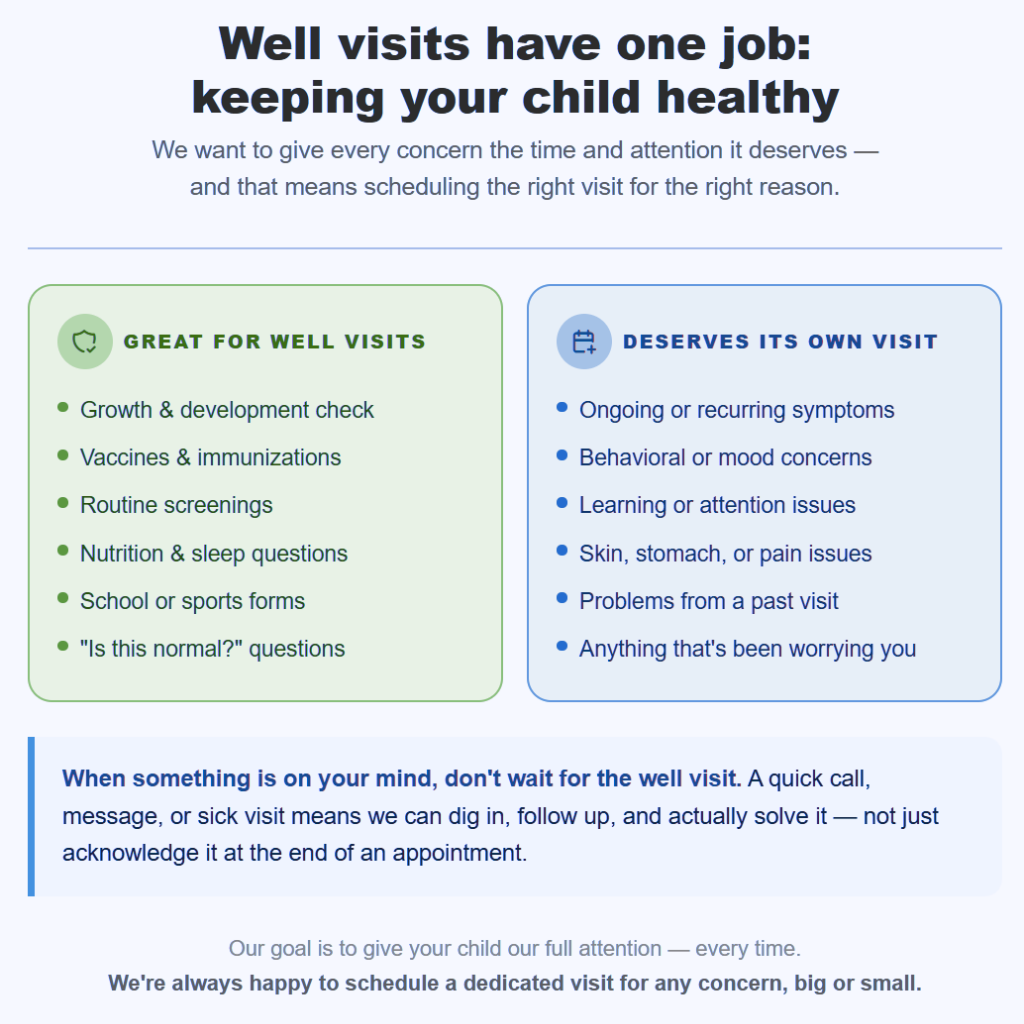
- Well-child visits: Annual well visits or physicals are recommended once a year after 3 years of age and more often prior to that. Summer is a great time to schedule annual checkups but spots fill quickly. Schedule through your portal or call the office to schedule soon.
- Sports and camp physicals can be done at your annual well child visit as long as they are completed during the timeframe required on the form. If your child has already had a well visit outside the timeframe and is not eligible for another well visit, call to schedule a sports physical. Learn more about well vs sports physicals.
- Anxiety and depression that are managed medically require frequent follow-up visits with the prescriber until symptoms are stable. After that, follow-up with the prescribing clinician is usually recommended every 3–6 months. Some visits may be appropriate for telehealth. Therapy is recommended along with medication for the best treatment outcomes. Medications should not be stopped without a plan from the prescriber, and follow-up after stopping medication is important to monitor for returning symptoms. Working with a mental health professional for therapy is also recommended. We have a clinical social worker who is available. Learn more about our integrated mental and behavioral health services.
- Asthma is a chronic condition that requires ongoing monitoring. Anyone using medication to control wheezing or breathing symptoms should be seen at least every 6 months while well to update their Asthma Action Plan and adjust or refill medications as needed.
- ADHD requires regular follow-up to ensure adequate symptom control, whether a patient is taking medication or managing symptoms without medication. Patients taking stimulant medications should be seen at least every 3 months for monitoring and prescription management, in accordance with federal controlled substance regulations. Patients taking non-stimulant medications are generally seen every 3–6 months, depending on symptom control. Some ADHD follow-ups may be appropriate for telehealth.
- When a child is sick or injured, a visit is needed to evaluate symptoms, make a diagnosis, and create a treatment plan. Phone calls and portal messages alone are not enough to safely manage most illnesses or injuries. We offer walk-in hours, scheduled visits, and telehealth when appropriate. Our staff can help determine the best type of visit for your situation.
•
Health forms: Need health forms completed for summer camp or sports? Call ahead — we need at least 5 business days and a visit may be needed if your child's last annual well visit was outside the date range needed for the form. We require that the parent/student sections are completed before we will sign any form. Please complete your sections before sending us the form.