COVID Vaccine Information
COVID Vaccine Information
COVID Vaccine
Why stay up to date?
Getting the latest updated COVID vaccines is our best chance to reduce the risk of many harmful effects of COVID, ranging from missed school and work to severe infection, hospitalization, and Long COVID.
Vaccine benefits decrease 3-4 months after vaccination, so previous doses are not protective. New research shows that people who have gotten the latest vaccines have the lowest risk of Long COVID, compared to people who were previously vaccinated but hadn’t gotten the latest shots. Even previously healthy children and adults are at risk of Long COVID. This happens even after mild infections and we're still learning about the long term risks of infection on every organ system in the body.
What vaccines are available for 2024/25?
All three COVID vaccine manufacturers have developed updated vaccine formulations to better match current variants for fall 2024, and all three have now been authorized by the FDA—Pfizer (Comirnaty), Moderna (Spikevax), and Novavax (Nuvaxovid) for those over 12 years, and younger children can receive the mRNA vaccines.
Vaccine schedule
The 2024-2025 vaccine should be given at least two months after any previous COVID vaccine dose.
For those who do not have moderate to severe immunocompromise
Initial Vaccination
- Children ages 6 months-4 years should complete a multi-dose initial series (two doses of 2024-2025 Moderna or three doses of 2024-2025 Pfizer-BioNTech). All doses should optimally be from the same manufacturer for this age group.
- Everyone over 5 years of age should receive one dose of a 2024-2025 age-appropriate vaccine. A different manufacturer from past doses is allowable.
Previously Vaccinated
- Children ages 6 months-4 years should receive 1 or 2 doses of 2024–2025 mRNA vaccine from the same manufacturer as administered for initial vaccination, depending on the vaccine and the number of prior doses.
- Everyone over 5 years of age should receive at least 1 dose of an age-appropriate 2024-2025 vaccine from any manufacturer, regardless of past doses.
For those with a moderate to severe immunocompromising condition
Initial Vaccination
- Children ages 6 months and older should receive three doses of 2024-2025 mRNA vaccine (Moderna or Pfizer-BioNTech),
Previously Vaccinated
- Recommended vaccine and number of 2024-2025 doses are based on age and vaccination history. At least 1 dose of 2024-2025 COVID vaccine is recommended for children ages 6 months and older. Please see the CDC Table 2 for more details.
Thank you to Unbiased SciPod for these images!
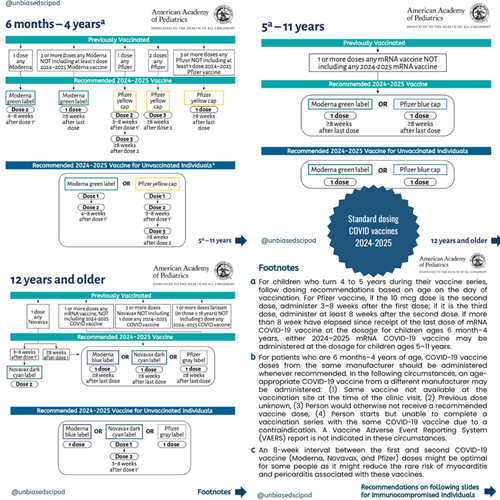
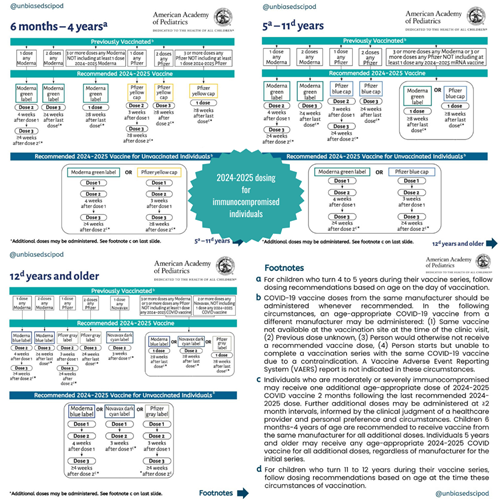
Yes, we recommend the vaccine for all eligible persons
We strongly recommend COVID vaccination annually for all eligible patients and their families to help prevent serious acute and chronic problems that can arise from SARS-CoV2 infections, even in young, healthy people.
What you need to know:
- Updated 2024-2025 COVID vaccines are available
- Pediatric Partners will have vaccine available for infants and young children only. Older children, teens, and adults can be vaccinated at pharmacies and the health department.
- The COVID vaccine can safely be given at the same time as other vaccines.
- A child should receive the age-appropriate vaccine product and dosage based on their age on the day of vaccination.For children who turn 4 to 5 years of age and are receiving Pfizer mRNA vaccine, if the 10 mcg dose is the second dose, administer 3-8 weeks after the first dose; if it is the third dose, administer at least 8 weeks after the second dose.
- “Mix and match” dosing between brands is allowed for children 5 years and older.
- For those under 4 years who are completing their primary series, it is preferable to use the same brand. Children uner 4 years who previously completed a primary series with one brand may switch to a different brand when receiving an updated dose.
- Who should get vaccines - and when?
- Everyone over 6 months of age is recommended to get vaccinated yearly.
- If you haven’t had a COVID shot within the last 2 months, you are eligible for updated boosters.
- Those who recently had a COVID infection may consider delaying COVID vaccine by 3 months from symptom onset or positive test (if infection was asymptomatic). Studies have shown that increased time between infection and vaccination may result in an improved immune response to vaccination.
- The 2024/25 vaccine is based on circulating variants.
- What is the cost?
- The updated COVID vaccines are covered by most private insurance plans, Medicare, and Medicaid.
- COVID vaccines are free for uninsured/underinsured children via the Vaccines for Children program.
- Check what may be available at your local health department.
Are the vaccines safe?
- The side effects have been similar to other routine vaccines- sore arm, redness, fatigue, fever, chills, headache, myalgia, and arthralgia. The side effects are temporary and mostly mild or moderate.
- Anaphylaxis has been observed following receipt of COVID-19 mRNA vaccines but this has been rare.
- Extremely rare cases of myocarditis or pericarditis have been reported – most often in males between 12-39 years of age, but it is important to note that infections with SARS-CoV-2 cause higher rates and severity of myocarditis than the vaccine.
- Additional information on common side effects and rare adverse reactions can be found here:
- Getting Your COVID-19 Vaccine | CDC
- Allergic Reactions after COVID-19 Vaccination | CDC
For more information on the vaccines for children:
For more information on Long COVID:
- Visit our COVID and Long-covid page
August 25, 2026
We will make every attempt to keep this page up to date.
Shipments and rollout for the updated formulas (targeting the JN.1-lineage XFG variant) are expected to arrive later this Fall, but we have not received confirmation of a shipping date.
We have ordered COVID vaccines for infants and children 6 months to under 12 years. If they are available in our office we will give them to eligible patients, but we will not offer mass vaccination clinics for this vaccine.
Pharmacies and the health department are offering COVID vaccines to those over 12 years of age. Johnson County KS Health Department information can be found here or you can search for your pharmacy or county's health department.
Those who are getting VFC vaccines (Medicaid, Native Americans, or uninsured) must meet the requirements as stated per the CDC for risk factors. We believe that insurance will cover these vaccines, but may require parents to sign an agreement that they will cover costs if insurance does not cover it because we cannot afford to cover this cost.
What are the FDA-approved COVID-19 vaccines for 2026/27?
Approved Vaccines for children and adults with high risk conditions and with shared decision making
- Moderna Spikevax. This vaccine is approved for children ages 6 months and older.
- Moderna Mnexspike. This vaccine is approved for children ages 12 years and older.
- Pfizer-BioNTech Comirnaty. This vaccine is approved for children age 5 years and older.
- Novavax Nuvaxovid.
This vaccine is approved for children age 12 years and older.
*High risk conditions include, but are not limited to the following: those most commonly seen in our clinics are in bold:**
- obesity (Body Mass Index (BMI) at or above the 95th percentile for children)
- lack of physical exercise
- diabetes (both types 1 and 2)
- cardiac, lung (including asthma and cystic fibrosis), liver, kidney, hematologic, and neurologic disorders
- ADHD
- mood disorders, including depression
- medical complexity
- smoker (current or past is included, but vaping is not specified)
Also, shared decision making is an option:
- advice from your healthcare provider (this is the shared decision-making option - yes, we want our patients to have this vaccine, so if your pharmacy asks you, we said to get it!)
There are no FDA-approved COVID-19 vaccines for “healthy” infants and teens, despite the known higher risk of children under 2 years of age and the proven safety and efficacy of these vaccines. The AAP and other medical organizations are advocating for continued use of these vaccines to protect all children and adults.
Pregnancy is listed as a high risk condition, yet there is no vaccine currently approved for use during pregancy. The CDC list itself states, “Completion of a 2-dose mRNA COVID-19 vaccination series during pregnancy was associated with a reduced risk of hospitalization for COVID-19, including for critical illness, among infants younger than 6 months of age,” but the FDA has failed to approve a COVID19 vaccine for use during pregnancy, so it is unclear if infants will be able to be protected during pregnancy.
AAP Recommendations
The American Academy of Pediatrics (AAP) and other professional organizations have released their recommendations that differ from the FDA this year.
The AAP recommends that:
- all children 6 months to 2 years of age get vaccinated against COVID-19
- all children who have not yet been vaccinated against COVID get vaccinated
- all high-risk children and children living with high-risk people should be vaccinated
- any child of a parent who desires vaccination should be able to be vaccinated
If children don't frequently experience severe illness with COVID-19, why do they need a COVID-19 vaccine?
- While rare, some children can become seriously ill with COVID-19 after getting the virus that causes COVID-19.
- A COVID-19 vaccine helps prevent children from becoming seriously ill or having to stay in the hospital due to the COVID-19 virus.
Will insurance cover COVID-19 vaccines?
Insurers are required to cover vaccines listed in the CDC immunization schedules, including shared clinical decision-making recommendations, which may qualify anyone for COVID vaccination.
This year insurers may consider the recommendations of medical professional groups, including the American Academy of Pediatrics (AAP), American Medical Association (AMA), and American College of Obstetrics and Gynecology (ACOG) to best protect their insured and to decrease overall hospitalization rates.
Do we recommend vaccination?
Yes, we recommend the vaccine for all who are eligible.
We strongly recommend COVID-19 vaccination annually for all eligible patients and their families to help prevent serious acute and chronic problems that can arise from SARS-CoV2 infections, even in young, healthy people.
Are the vaccines safe?
- The side effects have been similar to other routine vaccines- sore arm, redness, fatigue, fever, chills, headache, myalgia, and arthralgia. The side effects are temporary and mostly mild or moderate and much less significant than effects of infections with the virus.
- Anaphylaxis has been observed following receipt of COVID-19 mRNA vaccines, but this has been rare.
- Extremely rare cases of myocarditis or pericarditis have been reported – most often in males between 12-39 years of age, but it is important to note that infections with SARS-CoV-2 cause higher rates and severity of myocarditis than the vaccine.
- Additional information on common side effects and rare adverse reactions can be found here:
- COVID-19 Vaccine Information Sheet (VIS
For updates:
In addition to our updates, the AAP has a page of COVID-related news that you can check to see if there are any changes. Visit it on https://publications.aap.org/aapnews/news/1362/COVID-19-pandemic.
For information on Long COVID:
- Visit our COVID and Long-covid page
What can you do to help get your family protected?
Be an advocate! Call or write to your representatives to let them know you want the choice to have COVID vaccines for your family.
Find your reps: usa.gov/elected-officials
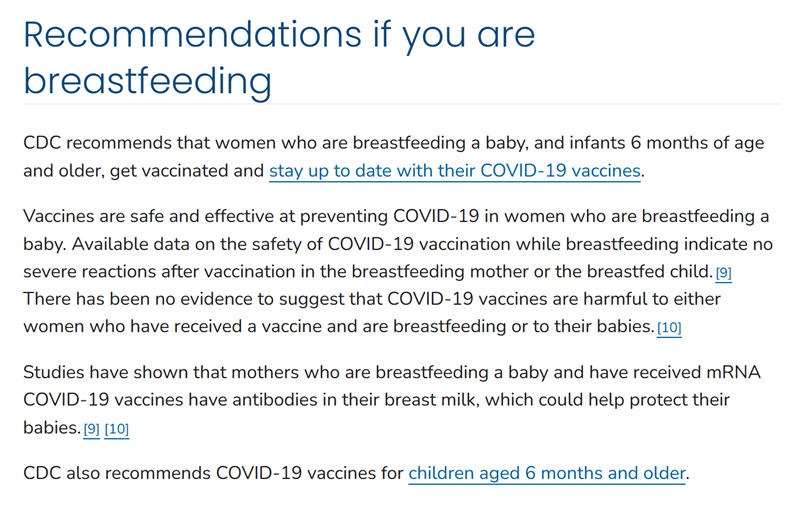
What if you're pregant or breastfeeding?
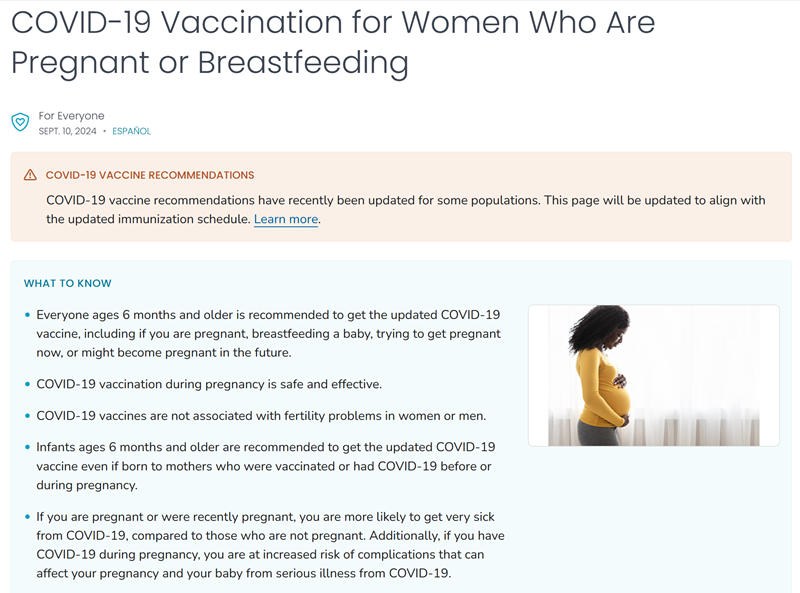
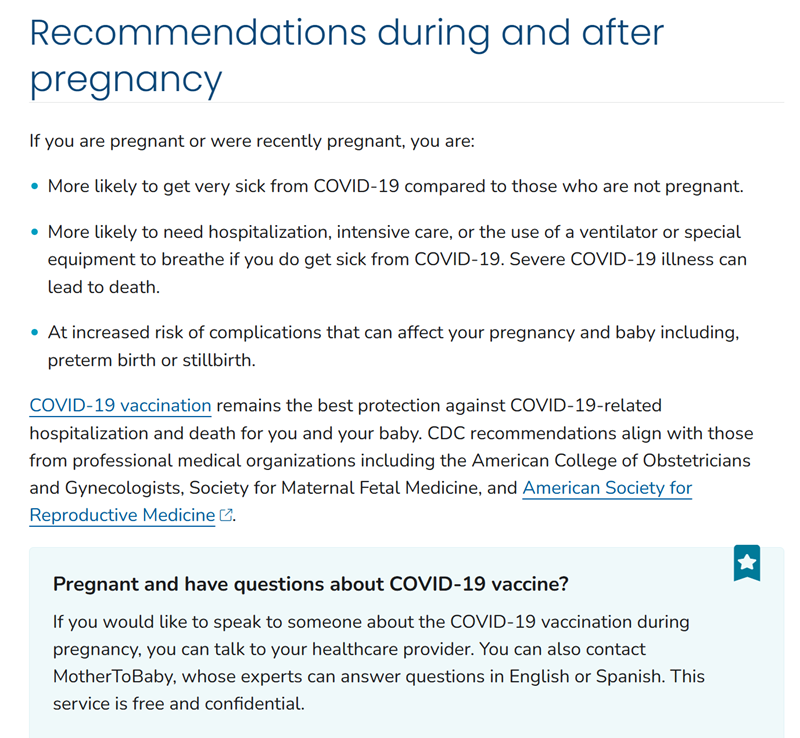
This is from https://www.cdc.gov/covid/vaccines/pregnant-or-breastfeeding.html but may change based on the orange box at the top:
Find information about long COVID