
24 Months
Some babies are born with a short frenulum under the tongue. This inhibits the baby from extending the tongue past the lips.
Many people refer to this condition as "tongue-tied" (medically called ankyloglossia).
The tongue’s frenulum attaches the tongue to the floor of the mouth. It should allow the tongue to extend past the lower gums and lip, elevate to the roof of the mouth, and move from side to side. If it is too thick, too short, or too far toward the tip of the tongue it can affect feeding, speech, tooth placement, and growth of the mouth.
Not all frenulums that appear thick need to be treated. If the tongue functions well and the baby is feeding successfully, we do not need to do any procedures. Dr. Stuppy has written a summary of the guidelines recommended by otolaryngolosts (ear, nose, and throat specialists) on management of tongue, lip, and cheek ties that you can read here.
Tongue tie affects about 4 in 100 people. It is more common in boys and there often is a family history of tongue tie.
- Check your baby’s weight (we check length and head circumference too at standard well visits)
- Ask about your baby’s feeding, bowel, and sleeping habits
- Do a physical examination
- Ask questions about development (in a pre-visit survey- watch for these texts before visits
- Ask if you have questions or concerns about your baby
- Update immunizations as recommended per our office schedule and standard guidelines
HOW IS IT TREATED?
We usually schedule the first visit 1-2 days after discharge. You will need to call to schedule this visit. Due to the nature of our scheduling availability, you may be asked to schedule with a member of our team that you have not yet met, but we think you'll like every one of our physicians and nurse practitioners. All have extensive training and experience and work well together to care for our patient families.
After the first visit newborns usually have several weight checks to be sure they are feeding well and establishing good weight gain. After that, they follow the typical
well visit schedule.
PHOTOS FROM STANFORD.EDU
Our physicians take turns seeing newborns in the hospital. You may get to see a face you already know or meet someone new, but we all trust our work teammates to take great care of our patients.
There are times that newborns require evaluation and care from a neonatologist (specialist in newborn care), such as if your baby is premature, has breathing difficulties, is suspected of an infection, or has need of intensive care. The local neonatologists will update us on how your baby is doing before they go home.
In the office
We see newborns at the following hospitals each morning:
WHEN THE TONGUE'S MOVEMENT AFFECTS FEEDING, A FRENOTOMY MAY BE RECOMMENDED
- Infection
- Bleeding (usually minor)
- Swallowed blood can lead to spitting up
- Damage to salivary glands (rare)
- Need for more surgery
- Feeding aversion
After the clipping the underside of the tongue will get a yellowed area (called "granulation tissue"). This is the normal healing tissue and will resolve within a few days.
What if your baby needs special care?
If you will be delivering at another hospital, just give us a call after you deliver to schedule your first visit. Please bring any paperwork given on discharge to your first visit. This may include your baby's birth weight, discharge weight, any lab values - such as bilirubin, screening results (such as hearing and cardiac screens) and any other information provided. This can help us learn about the hospital stay and continue care most effectively.
Newborns are scheduled to see one of our nurse practitioners or pediatricians for each visit. While we know that you will eventually see one of our staff primarily, initially it may be necessary to schedule with another person.
We all trust each other to work within our team, and newborns present the unique circumstance of needing a visit without much notice. Most of our routine well visits are scheduled 2-3 months in advance, so we hold spots for newborns, but it may not be with the person you will choose to see long term. We know this is not ideal because you want to introduce your baby to your chosen practitioner, but we cannot all have newborn spots open or it would cause scheduling issues for all the other patients - including your family long term. While we each have our unique personalities and bedside manners, we all follow standard care guidelines and will take great care of your little one!
If you want to learn more about us, check out the videos we have from each of our pediatricians, about our office locations, general medical advice we give and more.
Learn about each of the physicians and nurse practitioners on our individual pages.
- Work with lactation to improve latch
- Work with a speech pathologist or occupational therapist for feeding therapy
Kansas and Missouri each have routine newborn screens that are done in the hospital or birthing center to identify conditions that can be dangerous when not treated but not easily identified on a physical exam alone. The goal is to identify and treat diseases early enough to prevent serious complications such as growth problems, developmental delays, intellectual disabilities, blindness, deafness, and seizures.
You can learn more about the screenings from:
Risks of clipping:
Treatment of tongue tie involves lifting the tongue and clipping the frenulum (frenotomy).
A frenotomy can be done by trained pediatricians, ENTs, or dentists. Some of our pediatricians have this training, so if you're concerned we can make sure you get scheduled with one of them for an evaluation. There are local dentists who do a laser procedure, but this is more expensive and has not been shown to offer any benefit. (See Dr. Stuppy's review of guidelines for more details.)
The frenulum does not have nerves for pain, and most newborns tolerate the procedure well without any anesthetic. We usually ask that they feed immediately after the procedure to assess their feeding.
It is recommended if the frenulum is very thick, posterior, very vascular or if there is a family history of bleeding disorders that an ENT specialist does the procedure.
We work as a team at Pediatric Partners - from the front desk receptionists, to our nursing staff, to our nurse practitioners and pediatricians, we're all here to take the best care of your family!
- Advent Health -Shawnee Mission
- Overland Park Regional Medical Center
In the hospital
Most of the time we can start our relationship at the hospital when we see your baby soon after birth, but sometimes we begin care after they are discharged from the hospital. We generally see babies in our office 1-2 days after they are discharged from the newborn nursery or NICU.
If you choose our office, be sure to let the hospital know who your pediatrician will be. The hospitals call us after the baby is delivered and we will see you each morning.
One of our physicians will round each morning in the hospital to check on your baby, see how feeding is going, and treat most problems that arise. Most babies are in the hospital 2-3 days and we see them on daily rounds to evaluate how they are feeding, how much weight loss they have, perform a physical exam, and discuss parental concerns.
As mentioned above, we work as a team. Our pediatricians take turns rounding each day, so you may meet several of us during your stay at one of the above hospitals and it may not be the pediatrician you plan to see long term in our office, but we will be sure that person hears all about your baby.
What if you're delivering somewhere else?
We occasionally care for babies in the Newborn Intensive Care Nursery (NICU) if they are there for a short time and for minor issues.
We have a relationship with the Neonatologists (specialists in sick and premature newborn care) at each of the hospitals. They help care for the infants who are requiring more specialized care and let us know when they're ready to see us.
Alternates to frenotomy:
During the visit we will :
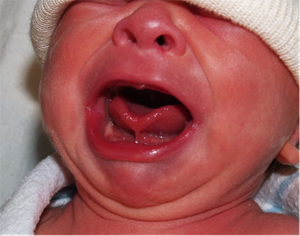
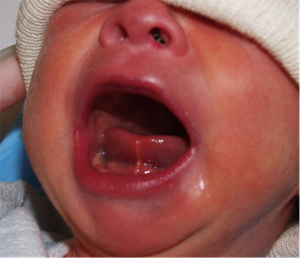
The pictures are the same baby before and after the frenulum was clipped.
PROCEDURE DESCRIPTIONS
MOGEN CLAMP:
The type of procedure done is dependent on the training and experience of the person performing the procedure. Risks and benefits overall are similar. The final "look" of the penis will be the same after the first week.
Both types use a local anesthetic called lidocaine to numb the area. This injection may sting initially (sugar and a pacifier are used to help pain control for the sting) and the injection may leave a bruise at the base of the penis. Babies can still feel the cold of the cleaning product we use to decrease risk of infection and they can still feel tugging, but the sharp pains of the procedure are lessened with the lidocaine. The foreskin is pulled away from the head of the penis (aka glans).
The remainder of the procedure done and aftercare depends on the type of circumcision.
There are two main types of circumcision, one that leaves a plastic ring (Plastibell) on the head of the penis, and another that removes the foreskin and is left open with petrolatum jelly on gauze.
Care depends on the procedure done. After a baby's circumcision, it takes about a week to heal regardless of the method used.
After the healing has taken place, no special care is needed other than routine cleaning.
We recommend putting petroleum jelly on the head of the penis during the healing process to keep it from sticking to the diaper. If stool gets to the area, simply rinse with water without rubbing the area much. Reapply petroleum jelly each diaper change. We suggest you do not use any creamy products or lotions on the healing penis, as they cause irritation.
- The foreskin is pulled up and the clamp is placed over the glans, to protect it from being cut.
- The clamp puts pressure on the tissues to prevent bleeding.
- The foreskin above the clamp is removed.
- No stitches are needed unless there is excessive bleeding, which is a rare complication.
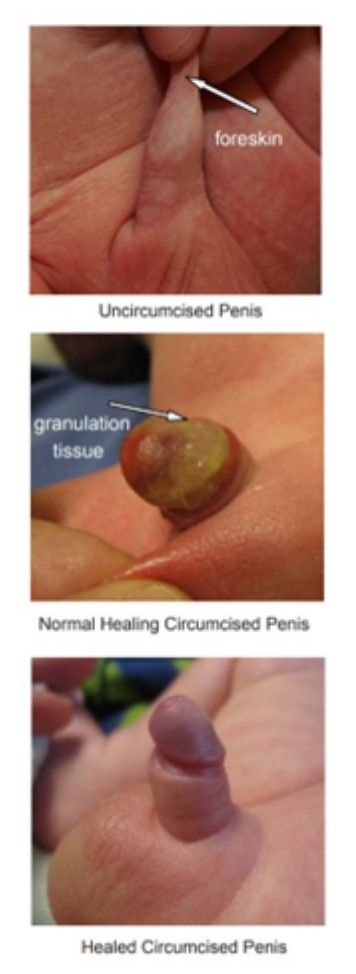
- The head of the penis will look open and raw during the healing process. This is normal!
- Change the gauze pad with petrolatum jelly (Vaseline) with diaper changes since it will be soiled.
- Rinse the head of the penis with water if stool (poop, bowel movement, meconium) gets on it, but usually simply changing the gauze is sufficient.
- Continue to place Vaseline gauze on the head of the penis until it is healed. You will know when it is healed when there are no more red or yellow areas.
- If there are signs of infection, such as redness of the penis shaft, temperature over 100.4F, poor feeding or fussiness, your baby should be evaluated.
Sometimes the penis will sink into the fat pad surrounding it, allowing the skin to reattach over time.
If your child's foreskin comes back over the head of the penis, push back on the fat pad to pull the skin off the head of the penis with diaper changes. Apply petrolatum jelly (Vaseline) to the area to prevent sticking.
If it does stick, it is called an adhesion. This usually doesn't cause any problems - remember that uncircumcised penises generally pull away from the foreskin over the pre-pubertal years. The adhesions of a circumcised penis will also naturally pull away over time. If they cause pain, they should be addressed.
A white substance called smegma sometimes is seen around the edges of the head of the penis. This looks like cottage cheese and is sometimes mistaken for pus. It is not pus and is a normal substance made by the penis. Gentle removal with a moist cloth is all that's needed if it's bothersome.
Circumcision types and care
The foreskin is attached to the head of the penis at birth and will usually naturally pull away over the first few years of life. A white substance may be seen as the foreskin pulls back. This is smegma and normal, not a sign of infection.
As long as the foreskin doesn’t easily retract, only the outside skin needs to be cleaned.
If the foreskin retracts a little, clean only the exposed area with water. Don’t use soap on this area - this can irritate the skin. After cleaning always replace the foreskin back over the head of the penis.
As your child gets older and the foreskin has completely separated and retracts easily, begin to teach him to clean underneath it as he bathes.
If the foreskin does not naturally pull away from the head of the penis an this causes painful erections, bring your child in for an evaluation of the situation.
Uncircumcised penis
A WORD ABOUT ADHESIONS...
After the Mogen Clamp it will look bright red and swollen initially, then less swollen. As it heals, yellow granulation tissue appears on the head of the penis. This is normal and NOT an infection.
PLASTIBELL
- A plastic ring (Plastibell) is inserted between the head of the penis and the foreskin and tied off.
- The ring is left in place until it falls off naturally, generally 3-7 days later.
- Routine cleaning with diaper changes is done.
- If the ring does not fall off within 14 days or if it slips down the shaft of the penis, bring your baby in to be evaluated. This is an emergency if it seems red, tender, or your baby has a temperature over 100.5F, is fussy or not feeding well.
- Track your child's development with FREE online tools.
- Find developmental milestone information so you can keep track at home.
- Pathways offers resources for infant and child development.
- Zero to Three offers resources for infant and child development and parenting.
- Did you know you can sign up for free weekly texts coinciding with your due date to help with every stage of pregnancy and the baby's first year? Visit text4baby for more details.
Milestone Tracking and Tools to Maximize Your Child's Development
Childcare can be done in a person's home or in an established child care center. There are pros and cons to each, so consider your family's needs to start your search.
ChildCare Aware has a searchable database to help locate childcare providers, check licensing of childcare providers and see inspection reports. Click on the state to find providers in Kansas and Missouri.
To help locate a childcare provider, learn how to find the best childcare, and more use this searchable database: Childcare.gov. Use their Tip Sheets to help find the best care for your child(ren).
Local Resources to Optimize Development
- Parents As Teachers works with parents to teach them how to teach their infants through 3 year olds.
- Infant and Toddler Services provides therapies for Kansas infants and toddlers through 3 years of age with delays in developmental skills, such as speech and language or gross motor skills.
- First Steps provides therapies for Missouri infants and toddlers through 3 years of age with developmental delays.
Daycare:
Colic (Fussy baby) Resources:
- Period of Purple Crying http://purplecrying.info/
- All Babies Cry https://www.allbabiescry.com/


Hot topic: Injuries
Accidents and injuries are an inevitable part of childhood, especially during the toddler years when curiosity is at its peak and boundaries are still being explored. While we can't prevent every mishap, being prepared and knowing how to respond to injuries can make all the difference in ensuring your child's safety and well-being. Save this page for tips to manage all the common injuries!
- Cuts and Scrapes:
- Wash the affected area with soap and water to prevent infection.
- Apply an antibiotic ointment to reduce the risk of infection and promote healing.
- Use a clean bandage or adhesive strip to cover the wound and keep it clean.
- Bruises:
- Apply a cold compress (such as a bag of frozen peas wrapped in a cloth) to reduce swelling and ease pain.
- If the bruise is on a limb, elevate it to further reduce swelling.
- Monitor the bruise for any signs of infection or worsening symptoms.
- Bumps and Bumps:
- Apply a cold compress to the affected area to reduce swelling and relieve pain.
- Keep an eye on your child for any signs of concussion, such as vomiting, dizziness, or loss of consciousness. Seek medical attention if you suspect a concussion.
- Burns:
- For minor burns, run cool water over the burn for at least 10 minutes to soothe the pain and prevent further damage.
- Do not apply ice, butter, or ointments to the burn as they can worsen the injury.
- Cover the burn with a clean, dry cloth or bandage.
- Insect Bites and Stings:
- Remove the stinger if it's still lodged in the skin by scraping it out with a fingernail or credit card edge.
- Apply a cold compress to reduce swelling and itching.
- Monitor for signs of an allergic reaction, such as difficulty breathing or swelling of the face, and seek medical attention if necessary.
- Splinters:
- Use clean tweezers to gently remove the splinter.
- If the tweezers don't work, sometimes using duct tape can help. Apply a small piece to the area and pull it off in the direction of the splinter (as if you're pulling on it directly).
- Clean the area with soap and water and apply an antiseptic ointment.
- Cover the area with a bandage to prevent infection.
- If the splinter cannot be easily removed, many will work themselves out on their own over time. Watch the area for signs of infection: swelling, pain, drainage. If you're not sure if leaving them in is appropriate, have your child seen.
- Nosebleeds:
- Have your child sit upright and lean forward slightly to prevent blood from flowing down the throat.
- Pinch the soft part of the nose together with a tissue or cloth and hold it for 5-10 minutes.
- If the bleeding persists, seek medical attention.
Remember, it's crucial to stay calm and reassure your child during any injury. If you're unsure about the severity of an injury or how to treat it, don't hesitate to seek medical advice. Your child's health and safety are always the top priority.
Our website has many resources.
Some pages you might find helpful at this age include:
- Nutrition This page has several articles related to feeding your child.
- Some of the most common questions for this age are covered on:
- Thumb sucking and pacifier use
- How to Prevent Tooth Decay in Your Baby
- Immunizations This page has answers to all your questions about the vaccines we give and what to expect after vaccinations. At 2 years we give any seasonal and catch-up vaccines that are indicated.
- Safety This page has a large number of subtopics to learn all about safety and prevention topics for your family.
- Parenting Tips This page has tips on sibling rivalry, tooth care, sleep and more.
- Is your child sick? This page has a searchable list of articles to help manage illnesses.
- Medicine dosages Always make sure you're giving the right amount of medication to your baby. Over the counter medications won't say how much to give, so we have weight based guidance on our site. Tip: If you're buying over the counter medicines, usually the infant specific versions are more expensive than children's versions without any benefit other than a syringe. You can usually buy a syringe and children's syrup for less! Some common questions about medications are covered on:
- Acetaminophen (Tylenol)
- Ibuprofen
- How to give your child medications
- Special Needs for those of you with children who have special needs.
Development
- A two year old should start to be able to do circular scribbling, as well as vertical lines. Offer crayons or pencils under supervision.
- At this age a child should be able to build a tower of 6 blocks. Keep stacking toys around for play.
- Two year olds usually love balls and should be able to kick a ball well as well as throw it. Many enjoy hitting a t-ball. This helps with hand-eye coordination.
- Encourage running, kicking and climbing - with supervision!
- Speech in a two year old is changing rapidly. They are able to use two word sentences, have about a 50 word vocabulary and are able to use plurals. A general rule of speech: 2 of 4 words should be understood by a stranger at 2 years, 3 of 4 words understandable at 3 years and 4 of 4 words by 4 years.
- Toddler rules: I see it, I want it, it’s mine. Toddlers don’t share well. Anticipate problems and intervene as appropriate. Talk about sharing, using gentle touches, hugs not hits, etc.
- Expect curiosity about genitals - teach correct terms. Masturbation is usually normal, but learn red flags.
- Potty training: Kids develop at various stages and while some may be ready to potty train, others are not. Let them take the lead when to start potty training. Pushing too soon is more likely to cause long term problems. They are ready when they show interest (wanting to sit on a potty chair, wanting a wet diaper off, telling you when they are wet).If you push, they will resist. Show excitement and give praise for interest and any steps in the right direction (sitting on potty, peeing in potty, washing hands, etc).You can put the idea in their head… “I’m going to the potty. Boy, do I feel good! I went on the potty, didn’t get my pants dirty, got to flush the toilet, got to use the foamy soap, etc.” but don’t tell them directly to go. They resist being told anything!
- Screen time:
- You have probably realized that kids of all ages are drawn to screens (tvs, tablets, computers).
- Consider how screen time will affect your toddler's development by asking the 5C's - with age-specific advice: healthychildren.org/English/family-life/Media/Pages/kids-and-screen-time-how-to-use-the-5-cs-of-media-guidance.aspx
- Watch with your children to help them understand what they're watching and to apply it to the world around them.
- Designate media-free times, such as during dinner, and media-free spaces, such as bedrooms.
- Use the Family Media Use Plan tool from the AAP to help.
- Reading daily is critical at this age!! What a fun way to bond, to teach language and to continue a love of books!
Milestone Tracking and Tools
- Pathways provides weekly motor, communication, sensory, and feeding activities to support baby at their exact age and stage of development. They have a robust website and free app and we highly recommend using it.
- Zero to Three offers resources for infant and child development and parenting.
- Reading to your baby daily has been proven to boost development. The Imagination Library will ship a free book to your home monthly for your child(ren) from birth to 5 years.
Sign up here!
Local Resources
- Parents As Teachers works with parents to teach them how to teach their infants through 3 year olds. This is available to everyone and especially encouraged for first time parents and families who will not use a daycare center, since daycare centers work on developmental skills much like schools do for older kids.
- Infant and Toddler Services provides therapies for Kansas infants and toddlers through 3 years of age with delays in developmental skills, such as speech and language or gross motor skills.
- First Steps provides therapies for
Missouri
infants and toddlers through 3 years of age with developmental delays.
Feeding & Nutrition
- Toddlers should have meals and snacks offered at the same times each day. Don't let them graze on snacks all day long - think of snacks as mini meals with healthy food choices offered at a standard time.
- Offer small servings of each food. Children become overwhelmed by large portions of food and often will eat more if offered less.
- Your child may decide they don't like certain foods. Never force them to eat. Keep offering those foods every once in a while. As children get older their tastes change.
- Eat as a family whenever possible with all screens off.
- Parents choose the types of foods offered, children will decide how much they eat.
- Expect meal times to be messy. They're learning important self regulation and fine motor skills when they do it themselves!
- Keep the tv and other screens off while eating.
- Vitamin D 15 mcg or 600 IU/day is recommended for everyone over 6 months. Liquid versions are best tolerated in young children.
- Limit milk to 24 oz or LESS per day. Too much milk increases the risk of malnutrition and iron deficiency anemia. If you need a cow's milk substitute, talk to us about which is most appropriate for your toddler. Many (including almond, rice, and other milks) sound healthy, but offer little nutrition and are not appropriate for toddlers.
- Juice should be limited and other flavored drinks are still not recommended. They have too much sugar and fill toddlers without providing much nutrition (even 100% fruit juice).
Safety
- A fabulous local resource to help you learn about child proofing your home is Charlie's House. Ask us for furniture latches so you can secure bookshelves, dressers, and other furniture that may tip.
- Drowning danger: Never leave young children alone in bathtub. Keep toilet lids down & locked. Empty wading pools and buckets immediately after use.
- Put your shoe, cell phone, or purse in the back seat so you never forget a sleeping toddler in the car.
- Street safety: Teach toddlers to stay out of the street and hold hands if possible in parking lots and when crossing the street.
- Keep the poison control number in your phone. 1-800-222-1222
- Monitor toddlers near stoves, irons, heaters and fireplaces closely.
- Keep the water heater set to less than 120F to avoid burns.
- If you own guns, be sure they are stored properly locked with the ammunition locked separately.
- Don't allow kids nearby when you're mowing the lawn. Projectile objects can hurt those who are too close.
- Use sunscreen. Apply 30 minutes before sun exposure and repeat every 2 hrs as needed. If your child has sensitive skin, test a small patch of skin overnight before applying to the whole body.
- If you feel unsafe at home, see Safehome or call 913-262-2868.
- Keep cigarettes, matches and lighters out of sight and reach. Don't smoke or vape around children.
- If you are worried about your living or food situation, talk with us. Community agencies and programs such as WIC and SNAP provide information and assistance. Find information about this and more on our Community Resources Page. See the "Economic and Financial Help" tab.
- Tobacco-free spaces keep children healthy. Don't smoke or use e-cigarettes. Keep your home and car smoke-free. If you need help quitting, find information on our Community Resources Page.
- Car safety:
- Kids are safest rear facing until they exceed the height or weight limits of their carseat, then they should turn forward with the 5 point harness still in use.
- If you need a car seat sticker, ask us! They can help identify who to call in case of emergencies.
- Do not put kids in thick clothing under the seat belt in a car seat. Remove coats and put blankets on top of the seatbelt.
- Make sure your child always stays properly strapped in the car safety seat during travel.
- Always wear your lap and shoulder seat belt to better protect yourself in case of accident.
- Never drive after drinking alcohol or using drugs.
- Never text or use a cell phone while driving.
- Do not smoke or vape in the car - even if children aren't in the car, it is an enclosed space and your baby will be exposed to third hand smoke or vaping chemicals.
- Check your smoke and carbon monoxide detectors and replace batteries regularly.
- All parents should learn CPR and refresh skills every 2 years. For a list of CPR classes for both non-medical and medical professionals, search for "CPR" with your zip code on a web search engine.
- Always leave contact information with babysitters. For more babysitter tips, see our
Babysitter page.
Health
- At 2 years, most kids do not have any required vaccines. We may offer catch up vaccines and seasonal vaccines when they're available. Review the vaccine schedule before your visit.
- Young children often seem like they're sick all the time. They get 8-12 colds a year, and each lasts about 2 weeks (some less, some more). Treat symptoms:
- Saline can be more helpful than many imagine. Nasal spray for infants is available at your pharmacy. Your child may also be old enough for nasal rinses at this age. Nasopure has written information and videos on how to use nose washes. Check out their library to learn proper technique!
- If there is nasal congestion or a runny nose, use a nasal aspirator to suck mucus from the nose. First use saline to loosen the mucus, then one of the aspirators that you provide the suction with your mouth or an electronic aspirator. We do not recommend bulb syringes because they are less effective and traumatize the nose more.
- Fever is the body's immune response at work.
- Temperatures over 100.4F are considered a fever and keep babies out of daycare, but we only use fever reducers to make kids comfortable, not to bring the temperature to normal.
- There is no temperature we worry about more if babies are over 3 months and vaccinated. The child's symptoms are what we watch, not the thermometer.
- Generally over 102F, the fever itself leads to discomfort enough to need a fever reducer, but they can be used for temperatures less than that if babies have fussiness, won't eat, or can't settle to sleep.
- Acetaminophen can be given every 3-4 hours and Ibuprofen can be given every 6-8 hours, so many parents prefer ibuprofen for less frequent dosing, but use the one that works best for your child.
- When to have your toddler seen:
- If the fever lasts more than 3-5 days.
- If there are signs of difficulty breathing (rapid breathing, sucking in ribs or at the bottom of the neck, grunting, or looking scared) seek medical attention.
- Signs of dehydration include lethargy/very tired, no tears, dry tongue, and decreased urine output. If this occurs, your child should be seen.
- A phone call cannot diagnose a source of fever.
- If your child has ear pain, treat the pain. Most ear infections are due to a virus, but if your child is under 2 years, the symptoms persist more than 3-4 days, or if the symptoms are not manageable, antibiotics may be considered. Learn more about ear infections here.
- We recommend that all caregivers stay up to date on their immunizations to help protect infants. If a caregiver is sick, they can use precautions to limit exposure to others, especially infants.
- ASK (Autoimmunity Screening for Kids) is a free, research-based program that screens for T1D and celiac disease.
- For people 1 to 99 years old
- No family history of T1D required
- No current or past diagnosis of diabetes
- Visit AskHealth.org to learn more.
- Tobacco-free spaces keep children healthy. Exposure increases risk of frequent ear infections and wheezing. Don't smoke or use e-cigarettes. Keep your home and car smoke-free. If you need help quitting, find information on our Community Resources Page.
- Tooth and oral care:
- Most experts say there are no symptoms associated with teething, but many parents report pain, fussiness, runny nose and loose stools.
- Teething pain should be managed with massage, cold cloths, chew toys or a pain reliever, such as acetaminophen.
- Do not use amber necklaces or teething gel.
- Oral hygiene and cavity prevention:
- Use a soft toothbrush twice a day with a grain of rice amount of children's toothpaste with fluoride.
- We offer fluoride varnish until kids start seeing a dentist - ask about it at your check up if you have questions!
Looking ahead to the 30 month visit:
We'll talk about
- Taking care of your toddler, your family, and yourself.
- Developmental milestones - use the tools above to prepare!
- There are no routine vaccines again until 4 years, but we may offer seasonal or catch up vaccines. Review the vaccines we'll give before your visit.